Trucking Navigates Road Ahead
By Big Data Federation, Inc.

-
Trucking freight volumes grew seasonally but remained below historical norms
-
Oversupply due to an owner-operators influx and a private fleet expansion
-
Rates stabilize as public carriers trim tractor counts in efforts to limit supply
Trucking freight volumes, measured as load counts, increased incrementally but remained below historical norms (2% MoM/ -6% YoY / -3% YoY4). Seasonality played a role since truckers are in the midst of the peak season. Another part of this shift can be attributed to public carriers who have onboarded freight back to the market after the now defunct less-than-truckload (LTL) carrier, Yellow, ceased operations.
| Data (September) | MoM | YoY | YoY41 |
| Truckload Counts | 2% | -6% | -3% |
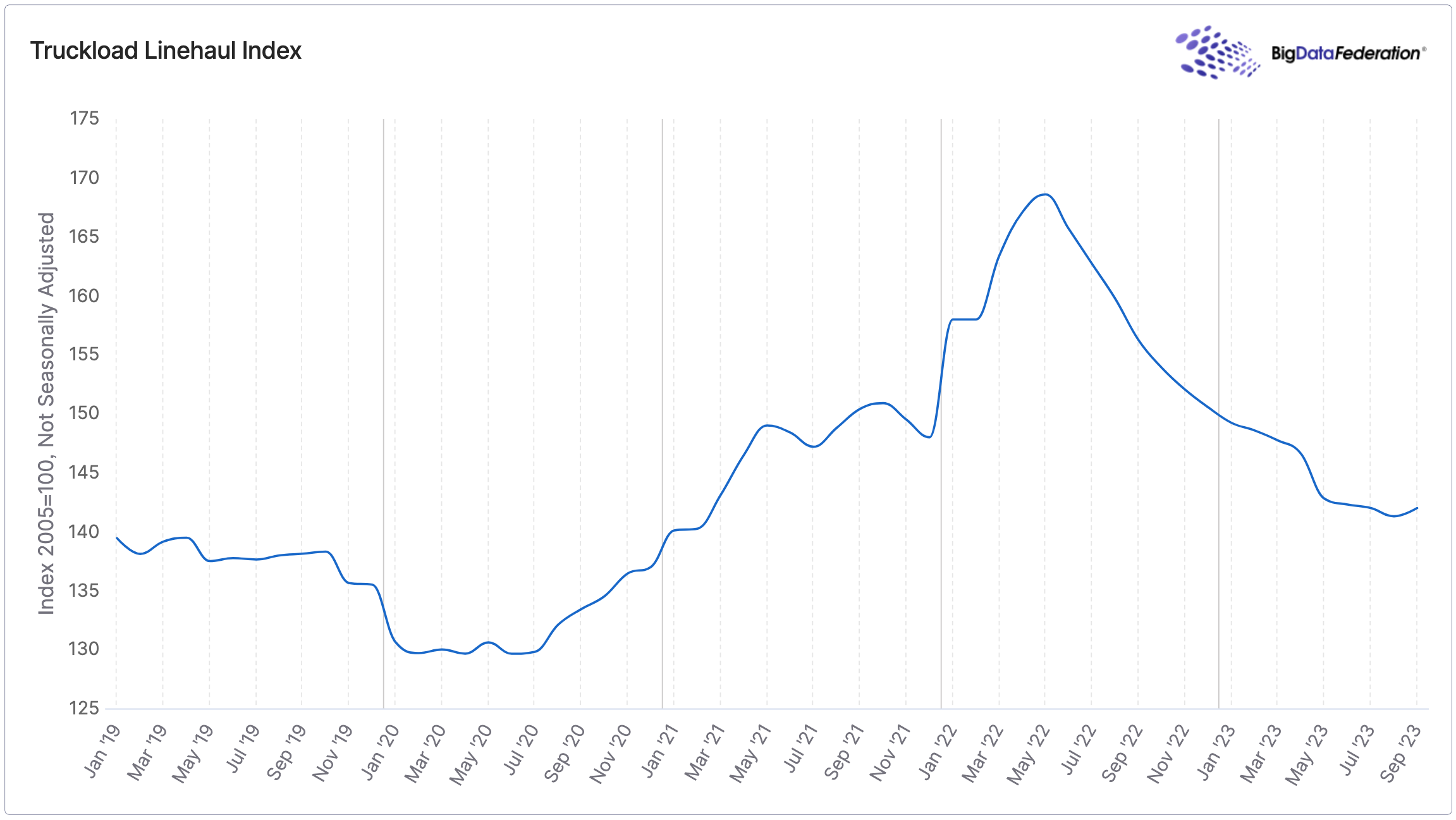
| Truckload Linehaul Index | 1% | -9% | 3% |
Source: Big Data Federation, Inc.
Oversupply continued to be an issue due to an influx of small new fleet operators, including owner-operators, amidst the tight conditions of the pandemic. Moreover, several companies undertook efforts to expand their private fleets for better transportation efficiencies. Benefits included reduced costs, larger distribution networks to gain greater operational control of supply chains, and less reliance on third-party carriers. As a result, private fleet expansion showed rapid and substantial growth, steadily encroaching upon the market share of the for-hire market.
Public carriers have trimmed tractor counts in efforts to limit supply. As such, per-mile truckload linehaul rates, separate from added costs such as fuel and accessorial charges to reflect baseline trends, rose modestly (1% MoM / -9% YoY / 3% YoY4). Spot rates have appeared to stabilize after several consecutive declines; contract rates are usually higher and adjust gradually.
1 YoY4 = comparison with September 2019
Published by Big Data Federation · All insights · Subscribe to Insights