Shocking Electric Bills Ahead
By Big Data Federation, Inc.
-
American consumers have been spending more on electric bills due to higher commodities prices, hybrid work, electrification of the transportation fleet, and growing capital investment.
-
Natural gas and coal comprise two-thirds of electricity generation in the U.S., with prices for both mounting since the Russia-Ukraine war.
-
Warmer temperatures in the summer and planned capital expenses on infrastructure should maintain upward pricing pressure.
American consumers have been spending more on electric bills (+3% MoM/+20% YoY/+28% YoY3). A far cry from the past decade, where it's remained relatively flat on average. Culprits include higher commodities prices, hybrid work, electrification of the transportation fleet, and growing capital investment.
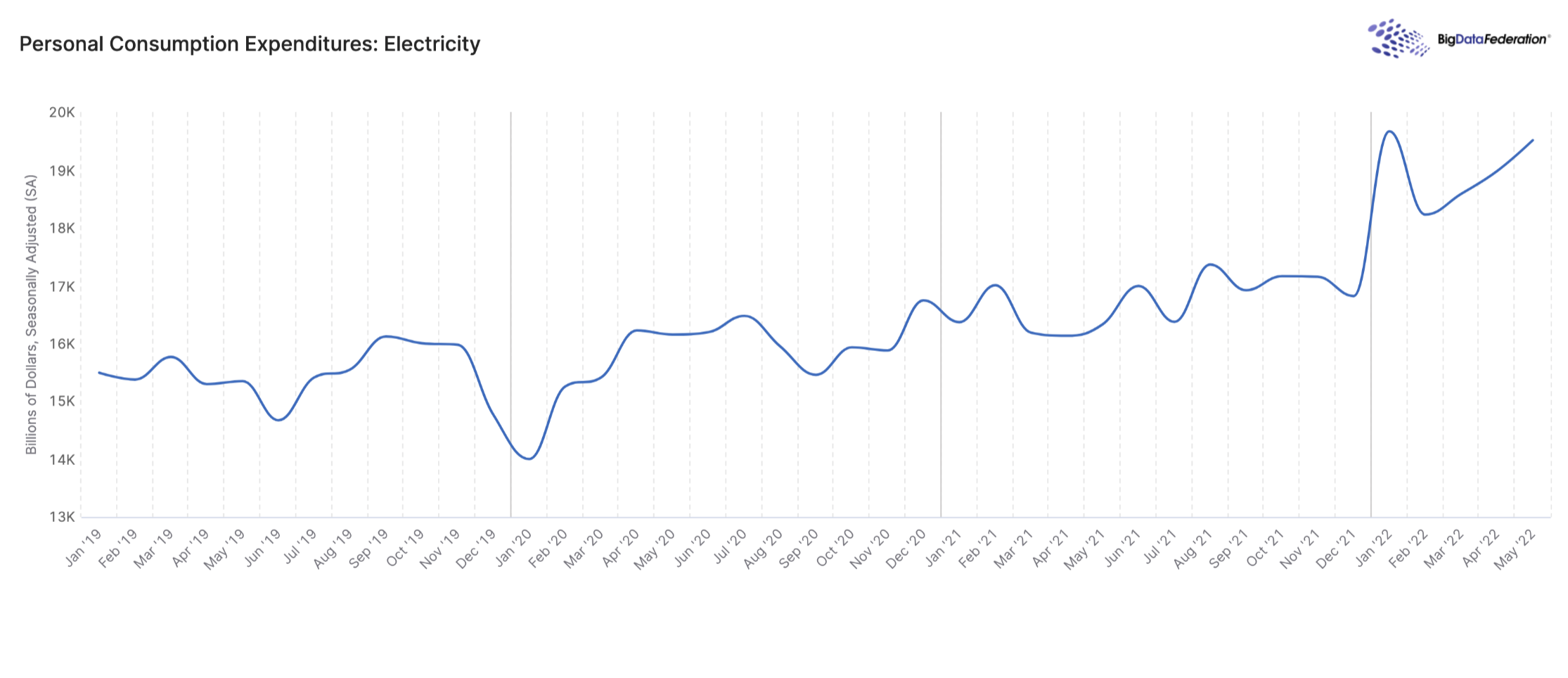
Currently, two-thirds of electricity generation in the U.S. relies on natural gas and coal. Soaring natural gas prices due to the ramifications of the Russia-Ukraine war have already contributed to costly winter power bills. Similarly, coal prices have also rocketed due to the same reasons.
Consequently, average electricity rates per kilowatt hour (kWh) surged dramatically (+2% MoM/+10% YoY/+13% YoY3).
Electric output has improved (+8% MoM/+7% YoY/+6% YoY3) to accommodate elevated demand. Notably, residential consumption has climbed due to the continued hybrid work model and expanded adoption of electric vehicles (+13% MoM/+4% YoY/+3% YoY3). Throughout the summer, seasonally higher temperatures will boost air conditioning usage leading to strengthening demand.
| Data (May) | MoM | YoY | YoY31 |
| Personal Consumption Expenditures: Electricity | 3% | 20% | 28% |
| Average Electricity Rates p/kWh | 2% | 10% | 13% |
| Electric Output | 8% | 7% | 6% |
| Residential Electricity Usage | 13% | 4% | 3% |
| Utilities Employees | 0% | -1% | -2% |
| Hourly Earnings for Utilities Employees | 2% | 6% | 13% |
| Source: Big Data Federation, Inc. |
Moreover, utility companies are significantly growing capital expenditures. Investments aim to upgrade grids to ensure reliability as aging infrastructure has become more susceptible to sustained power outages. Additionally, it should aid the accommodation of increased demand from the transition to renewable energy. All of which will show up in utility bills sooner or later.
1YoY3 = compared to May 2019
Published by Big Data Federation · All insights · Subscribe to Insights