How Much Can Banks Push Lending In This Economic Climate?
By Big Data Federation, Inc.

Notwithstanding the Federal Reserve’s monetary arm flexing, overall lending activity in April continued to rise (+1.2% MoM, +7.3% YoY, +8.5% YoY3) driven by consumer credit card spending, residential real estate loans, and commercial borrowing. Banks prefer a higher loan-to-deposit ratio (80% or more) to enhance revenue, but with such high liquidity on bank balance sheets, loans as a percentage of total assets were just over 49% in May, and only slightly up from pandemic lows of 47%. On the flipside, commercial banks’ pandemic-boosted liquidity buffers provide resilience to support credit flows and preserve balance sheet integrity.
High commodity prices, strong consumer demand, and wage spirals have all contributed to inflation. In a bid to knock this on its head, in April the U.S. central bank raised its benchmark rate by a half-a-percentage point, following a quarter-point increase in March. It has plans for more. With looming rate hikes, banks hoping to deploy stockpiles of liquidity will need to compete aggressively for borrowers.
Bank Balance Sheet Data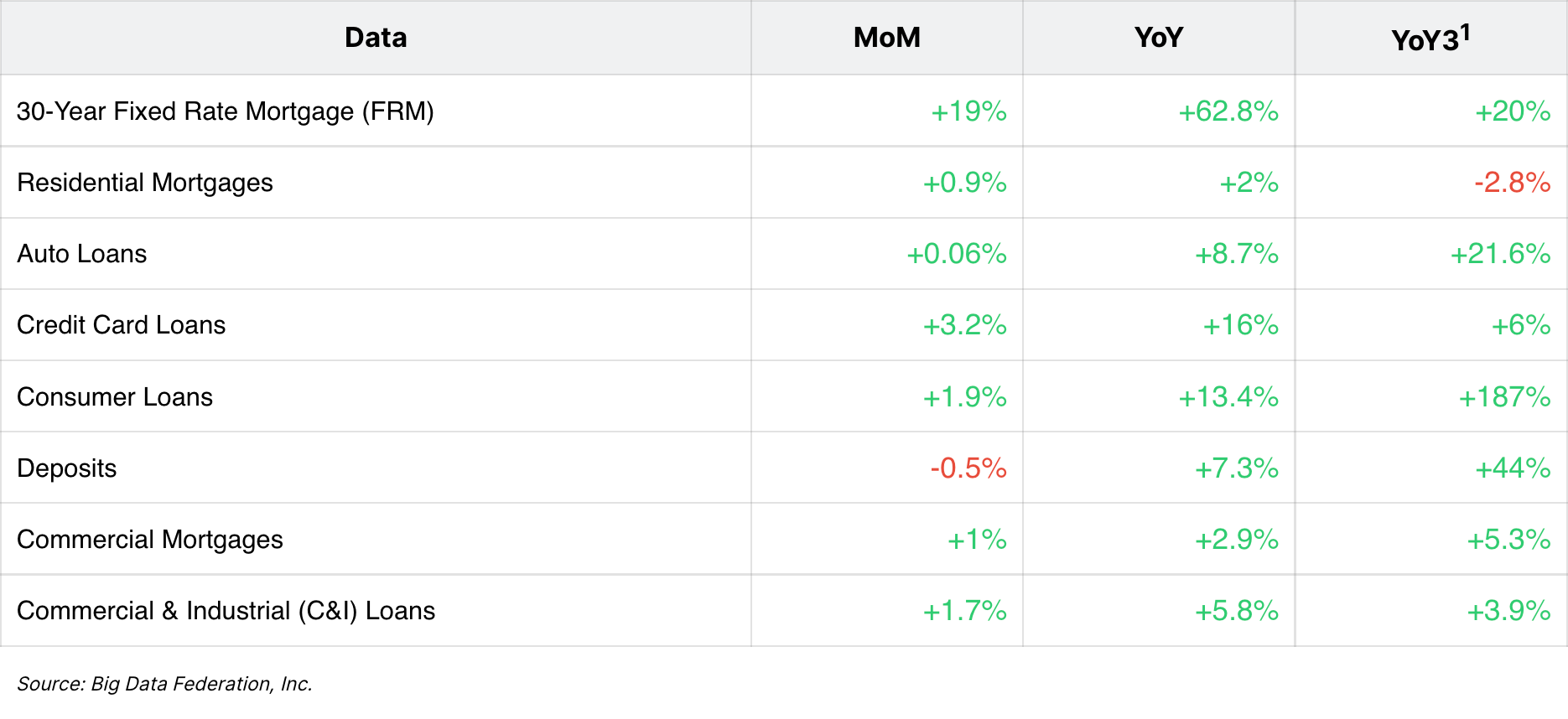
Residential Mortgages
Monetary tightening drove up the 30-Year FRM (+19% MoM) to just shy of 5% (4.98%) in April; slightly higher than FRMs last seen in 2018 (then driven by a healthy economy and prospects of higher inflation). Home mortgage growth has been slowing (+0.9% MoM) and there was a decline in the number of applications to purchase a home (-6.3% MoM; -7.8% YoY3) with average loan size (-0.7% MoM; +34.7% YoY3) reflecting a mixed bag. These trends are continuing in May: -6.1% MoM (-10.5% YoY3) and -2.3% MoM (+32.6% YoY3) to date.
Consumer Loans
Consumer credit card loans now exceed pre-pandemic levels (+6% YoY3/+3.2% MoM) and buyers seem to be thinking twice about big-ticket spending, especially on goods. With record-high car prices and rising interest rates, auto loans flat-lined in April (+0.06% MoM) during a season when many people usually use tax-refunds to fund auto purchases. However, services-driven consumer spending on travel and entertainment could persist until the end of summer.
Deposits
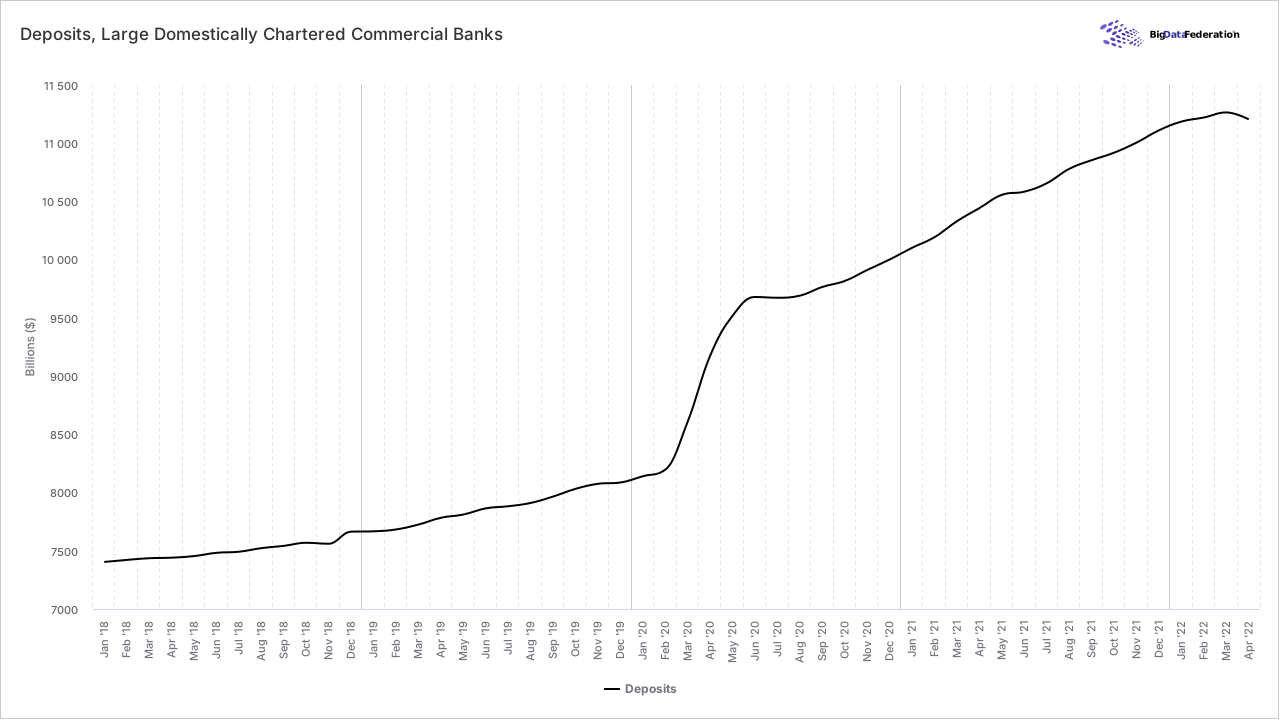
Consumers have begun spending down their pandemic-built savings (-0.5% MoM). A combination of fewer deposits and depositors pulling out cash led to a decline in commercial banks’ cash assets in April (-10% MoM). Of note, these deposits are still significantly higher than pre-pandemic levels (+44% YoY3) and at the current rate of reduction, it would take until the end of 2023 for deposits to fall to amounts last seen three years ago.
Commercial Mortgages
Demand for mortgages for commercial real estate (e.g. office buildings, shopping centers/malls, hotels) took a hit from stay-in-place and work-from-home policies, bottoming out in May 2021. With an expanded economic reopening at the end of 2021, demand has recovered at an increasing pace. In April, loans were above 2019 levels (+5.3% YoY3) and grew +1% MoM (quite significant for this loan type). With ongoing demand for hotels, people returning to the office, and more apartments still needed, this lending business has strong fundamentals.
C&I Loans
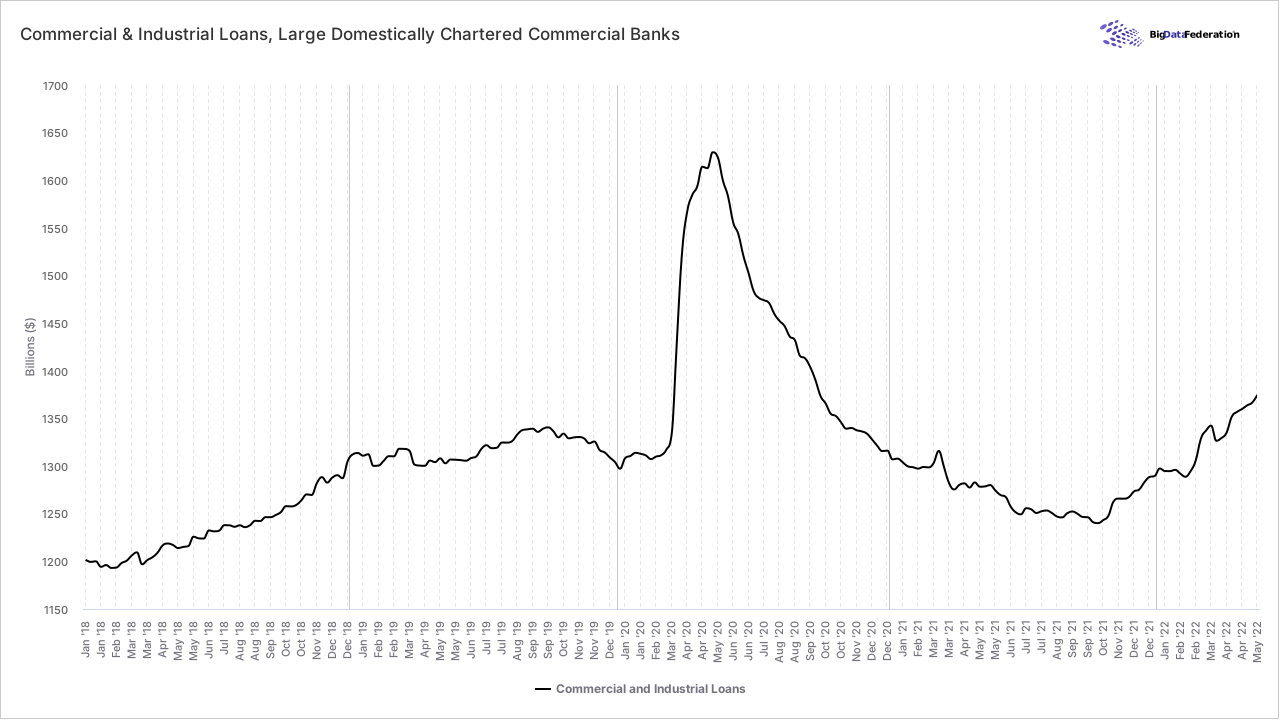
During the initial months of the pandemic, businesses accessed untapped C&I credit resulting in a spike in May 2020. The Small Business Administration’s (SBA) Paycheck Protection Program (PPP) introduced in May 2020 and which ended a year later played a huge role in the provision of additional credit in the form of forgivable loans. This liquidity support was provided by the government to banks and not businesses directly, thus resided on banks’ balance sheets but lenders did not incur any credit risk. By October 2021, C&I loans had fallen to levels last seen in 2018, in part reflecting continuing declines in PPP loans through loan forgiveness and repayments. Offsetting lower PPP-related income, organic borrowing gradually increased as business owners started to look for new sources of funds to expand and build up inventories. By April, C&I loans were up (+1.66% MoM) and exceeded pre-pandemic levels (+3.9% YoY3). While business confidence (Manufacturing ISM) was down in April (55.4) from March (57.1), it stayed above the long-term average (53.02) and well above overall 2019 levels, providing the necessary demand for commercial loan growth. The decline in confidence was mainly due to labor shortages across the supply chain and not due to a decline in consumer demand. However, in May, we are seeing hiring freezes by mostly tech companies and an increased frequency in layoffs. As such, demand for C&I loans could be curtailed in the current small and medium business environment.
Conclusion
Despite the drawdown in consumer deposits and higher credit card balances, high savings rates during the pandemic mean banks still have ample funds on hand (+82% YoY3). In addition to cash, banks hold other easily-sellable assets including government-affiliated mortgage-backed securities (+44.7% YoY3), Treasury securities (+162% YoY3), and non-government securities (+30.4% YoY3). These combined stockpiles provide banks with needed liquid funds to meet the demand for loans and/or deposits. Banks will need to continue to find avenues to put these funds to work, through both consumer and commercial lending. In this increasingly high interest rate environment and uncertain economic outlook, this might become more challenging.
1YoY3 = compared to April 2019
Published by Big Data Federation · All insights · Subscribe to Insights