On the Rail to Recovery
By Big Data Federation, Inc.
Rail freight moves almost one-third of U.S. freight, eclipsed only by trucking (~40%). During 2020, rail freight industry revenues fell -11% YoY as U.S. manufacturing1 slowed and global freight transportation suffered delays. In 2021, with continued strong demand for consumer goods accompanied by recovery in the manufacturing sector, our algorithms predict U.S. rail freight industry revenues will grow +14% YoY (+1.5% above pre-pandemic levels). As business as usual resumes in 2022 and beyond, our machines predict rail freight revenue growth will slow down to single digit inline with the GDP growth.
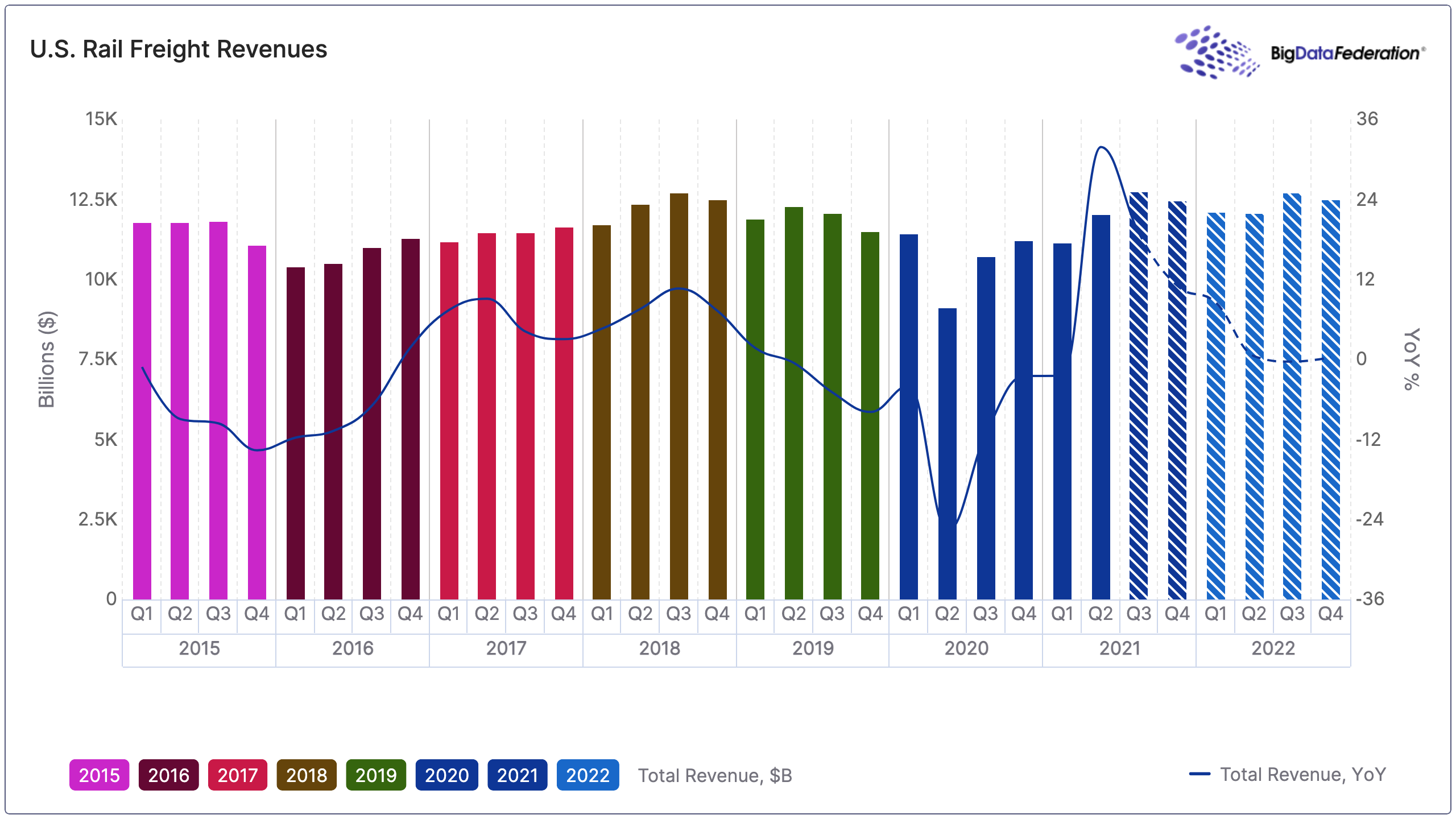
Beginning in 1Q20, a pandemic-fueled decline in Chinese manufacturing led to a slowdown in global ocean container shipments and an interruption in U.S. rail intermodal2 traffic activity. Demand for commodity carload3 shipments also fell as U.S. industrial production dropped (-8% YoY) due to stay-at-home orders issued in March. The first quarter witnessed its first pandemic-driven negative growth in rail traffic (-7% YoY) and rail freight industry revenues (-4% YoY, -1% QoQ).
Lockdowns and social distancing in 2Q20 drove U.S. consumer spending to shift from services to physical goods, leading U.S. e-commerce activity to soar +44% YoY; these trends continued throughout 2020 (+36.3% YoY in 3Q and +32% YoY in 4Q). Shipment orders placed in the second quarter to replenish depleted inventories didn’t land in the U.S. until the following quarter.4 While 3Q20 received a boost from second quarter elevated consumer goods spending, 2Q20 rail freight industry revenues plummeted (-26% YoY, -20.2% QoQ).
A surge in U.S. imports in 3Q20 led to an unusually large number of containers landing in ports. Containers are typically transported from ports by trucks but with a pandemic-fueled shortage of truck drivers, the trucking industry couldn’t handle the increased capacity. With rail freight less dependent on labor, demand grew for intermodal rail, prices rose ~30% YoY, and rail freight industry revenues improved (-11%YoY and 17.5% QoQ). These trends persisted into 4Q20 and rail revenues continued their recovery (+-2.5% YoY and 4.7% QoQ).
Strong demand for retail goods was sustained in 1Q21 (+19.5% YoY2, +16.4% YoY). However, extreme weather conditions (record snowfall and low temperatures) slowed and sometimes stopped rail movement for several weeks. Supply chain disruptions were further exacerbated when the Ever Given container megaship became grounded in the Suez Canal on March 23 causing a 6-day traffic jam and delays for over 200 vessels. U.S. rail freight revenues dropped (-6.3% YoY2, 2.5% YoY, -1% QoQ).
In 2Q21, U.S. manufacturing new orders climbed +3% YOY2 (+30% YoY, +6.4% QoQ). To meet growing demand, rail freight operators deployed longer trains to extend the network’s loading capacity. This led to an expansion in rail traffic for both intermodal (+8% YoY2, +23% YoY) and carloads (-8% YoY2, +23% YoY). Rail freight revenues continued to recover (-2% YoY2, +32% YoY, +8% QoQ).
Demand for consumer goods will continue to power intermodal rail traffic in 2H21 fueled by major shopping and holiday seasons including “back-to-school,” Black Friday, Cyber Monday, and Christmas. Carload shipments of raw materials, chemicals, and industrial output (vehicles and equipment) are also expected to see a rise in demand from U.S. factories. Our machines predict revenue growth of +4% YoY2 (+15% YoY) for the second half, and overall growth of +1.5% YOY2 (+14% YoY) for 2021.
As life returns to a new normal in 2022, consumer spending on both goods and services can be expected to pretty much resume to pre-pandemic levels. In the meantime, retailers will continue restoring depleted inventories well into mid 2022, thereby keeping rail yards at ports busier than seasonal norms. Our algorithms predict +4% YoY rail freight revenue growth in 1H22.
Once inventories have been replenished, demand for consumer-goods driven container shipments will likely decline in 2H22. On the flip side, shipments of industrial and raw materials goods will be boosted as a result of infrastructure investment projects under Biden’s planned $1.2 trillion infrastructure bill. For the rail freight industry, our machines predict flat revenue growth in 2H22 (0% YoY) and for 2022 overall (+2% YoY).
1 Based on US total manufacturing new orders (not seasonally adjusted).
2 Intermodal rail traffic includes shipping containers and truck trailers moved on rail cars. These can be handled by multiple modes of transportation (e.g., rail, ship, aircraft, and truck).
3 Rail carload services are trains comprised of a variety of railcars and commodity-carrying trains for liquid (oil) or dry goods (such as coal trains or grain trains), which can be moved only by rail.
4 In normal operating conditions delivery takes around 15-40 days; delays due to COVID added an additional minimum 10 days. Shipping goods from China to the US by sea takes approximately 15 days to the West coast, and 25+ days to the East Coast.
Published by Big Data Federation · All insights · Subscribe to Insights