Nursing Homes Growth Is Back
By Big Data Federation, Inc.

Typically, almost half of all nursing homes residents are 85 years or older.1 This demographic was hardest hit during the pandemic and accounted for ~30% of all COVID-19 related deaths in the U.S. (as of September 2021). In the first quarter of 2021, nursing homes hit rock bottom in terms of occupancy; with the vaccination roll out occupancy has seen a steady recovery. Our algorithms predict that soon nursing home companies in aggregate will report record revenues. Although our machines forecast a -2% YoY drop for 2021, they predict a +5% YoY rise in 2022 – higher than pre-pandemic levels and signaling business expansion.2
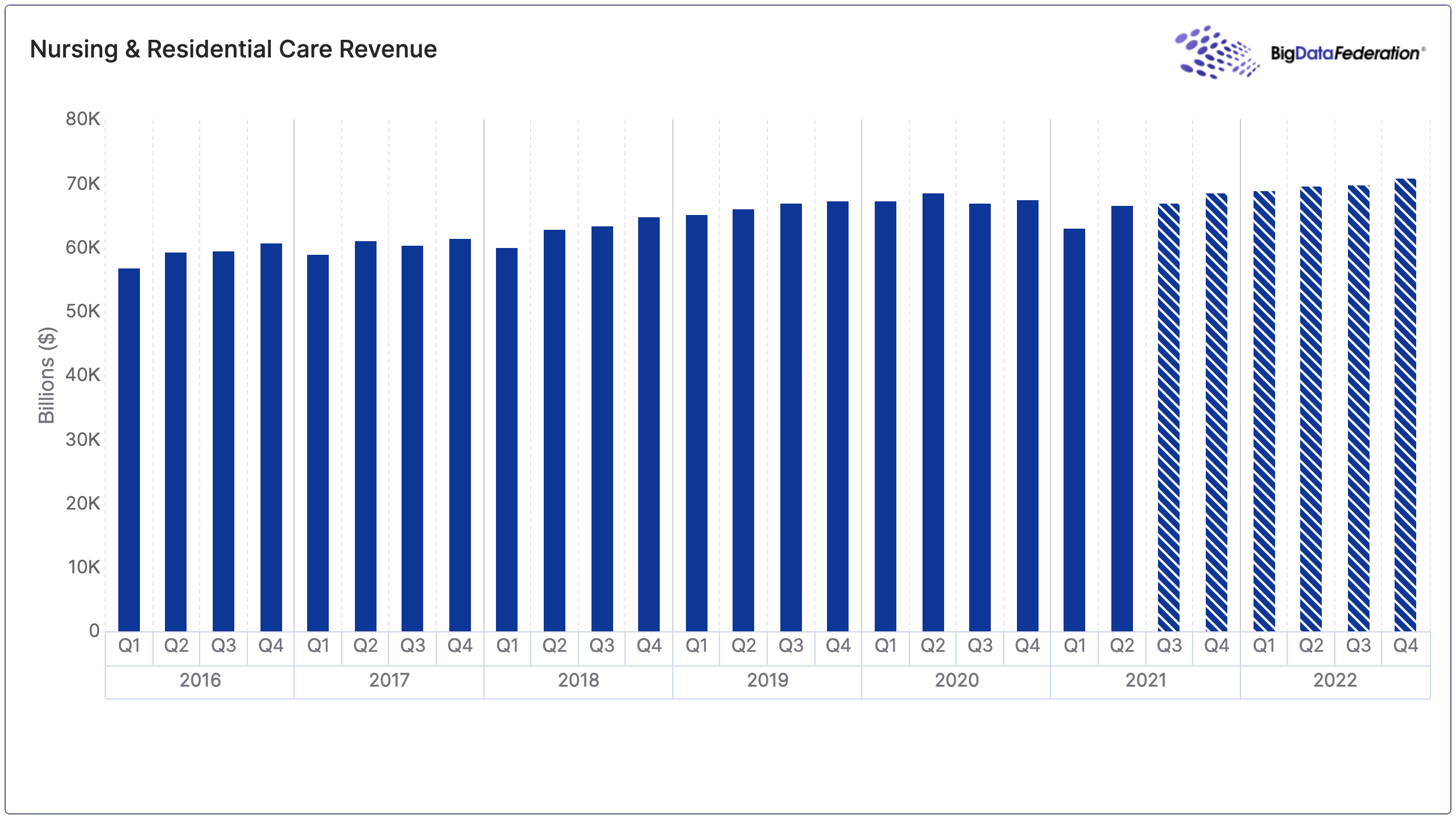
In 2020, growth in nursing home revenues (+2% YoY) was facilitated by changes in government regulations in response to the coronavirus emergency. Introduced on March 6, a “3-day waiver” policy led to faster admissions of high acuity (i.e. higher medical risk) patients to skilled nursing homes3 from overburdened hospitals, and thus higher Medicare reimbursement for nursing homes. In addition, $178B in provider relief funds (PRFs) were approved in 2020 to reimburse eligible health care providers (including nursing homes) for health care-related expenses or lost revenues attributable to the pandemic. These PRFs are includible in gross income. (N.b. At end of May 2021, $43.7B of PRF funds were still unallocated.)
A new policy implemented on May 1 2020 meant that nursing homes also received a blanket 2% payment increase in Medicare reimbursement rates, includible in nursing home revenues. This remains in effect until December 31 2021.
In 1H21 the industry saw a -4% YoY decline in revenues. For 1Q21, a peak in new coronavirus cases in nursing homes at the end of 2020 negatively impacted the number of elderly elective care cases as well as elders opting to reside in nursing homes. COVID vaccine rollouts begun in December meant there were fewer high acuity residents transferring from hospitals to nursing homes, and thus less reimbursement for nursing homes. Occupancy dropped to 68% and the industry experienced its lowest revenues (-6% YoY) since the start of the pandemic. Not even PRFs could make up the loss. As in previous second quarters, 2Q21 witnessed a growth in the number of elective care patients and a mild uptick in occupancy (+2.73% QoQ) but industry revenues were still negative (-3% YoY).
In 2H21, our algorithms predict industry revenues will show some recovery but will still be flat (+0.7% YoY). Further vaccine rollouts (including state vaccine mandates for nursing homes) and boosters will have a two-pronged effect. First, they will enhance demand for elective care by patients with chronic and age-related illnesses leading to more patient flow from hospital/surgical settings to nursing homes; this is despite the Delta variant. Second they will increase demand for non-acute elderly residential care. Towards the end of the year, with fewer people anticipated to be sporting masks, a resurgence in the flu season is expected to lead to an increase in high acuity residents admitted to nursing homes.
We anticipate that with the vast majority of people vaccinated by 2022, a +5% YoY growth predicted by our algorithms reflects an almost full post-pandemic recovery.
Nursing home real estate is considered a defensive property type. People need post-acute and long-term care no matter what the economy is doing. Typically, when the 10-year Treasury note yield rises, investors expect a similar increase in yield from income-focused investments like REITs. Since price and yield have an inverse relationship, falling rates tend to send REIT prices higher. This does not always hold and defensive industries are not without risk. Case in point: despite a zero percent interest rate introduced in March 2020, share prices for REITs with holdings in skilled nursing and senior housing facilities dropped during the pandemic. The good news is share prices for these REITs are in recovery. Ultimately, the fundamentals of this industry remain strong. With longer life expectancy and an increasing incidence of chronic and age-associated diseases, aging boomers are faced with few alternatives to nursing homes and residential care.
1 ”Nursing and residential care” industry includes nursing homes, continuing care retirement communities, assisted living facilities for the elderly, other residential care facilities, residential intellectual and developmental disability, mental health, and substance abuse facilities. The use of term nursing homes is for cases when the data is only for nursing homes. “Nursing home” industry provides care for older adults outside of a hospital.
2 Caveat: Barring a resurgence of COVID-19, changes in reimbursement, variations or delays in financial relief funding, and capped admissions due to labor shortage.
3 97% of Nursing Homes have skilled nursing services – medical care and rehabilitation services provided to elderly after surgical procedure or a hospital discharge.
Published by Big Data Federation · All insights · Subscribe to Insights