Post-Pandemic Renaissance of Equity REITs
By Big Data Federation, Inc.

Publicly traded real estate investment trusts (REITs) must distribute at least 90% of taxable income as dividends. REITs provide individuals an opportunity to invest across diverse property types. REITs can be categorized into either mortgage REITs (mREITs)—that invest in mortgages, mortgage-backed securities, and related securities— or equity REITs (eREITs)—that own and manage income-producing real estate. eREITs can own properties across 11 sectors1, and each reacts differently to economic conditions.
__________________________________
Effects of the pandemic slashed eREITs Funds from Operations (FFO)2 by -18.5% YoY in 2020. Recovery began in 1H21 as FFO increased +19% YoY; according to our forecasts, this acceleration continues into 2H21 with double-digit year-over-year growth in the mid-thirties. Our algorithms predict strong performance in 2022 with FFO year-over-year growth in the low-teens. Leading the charge will be eREITs operating in the Infrastructure, Self-Storage, Retail, Lodging, and Diversified sectors.
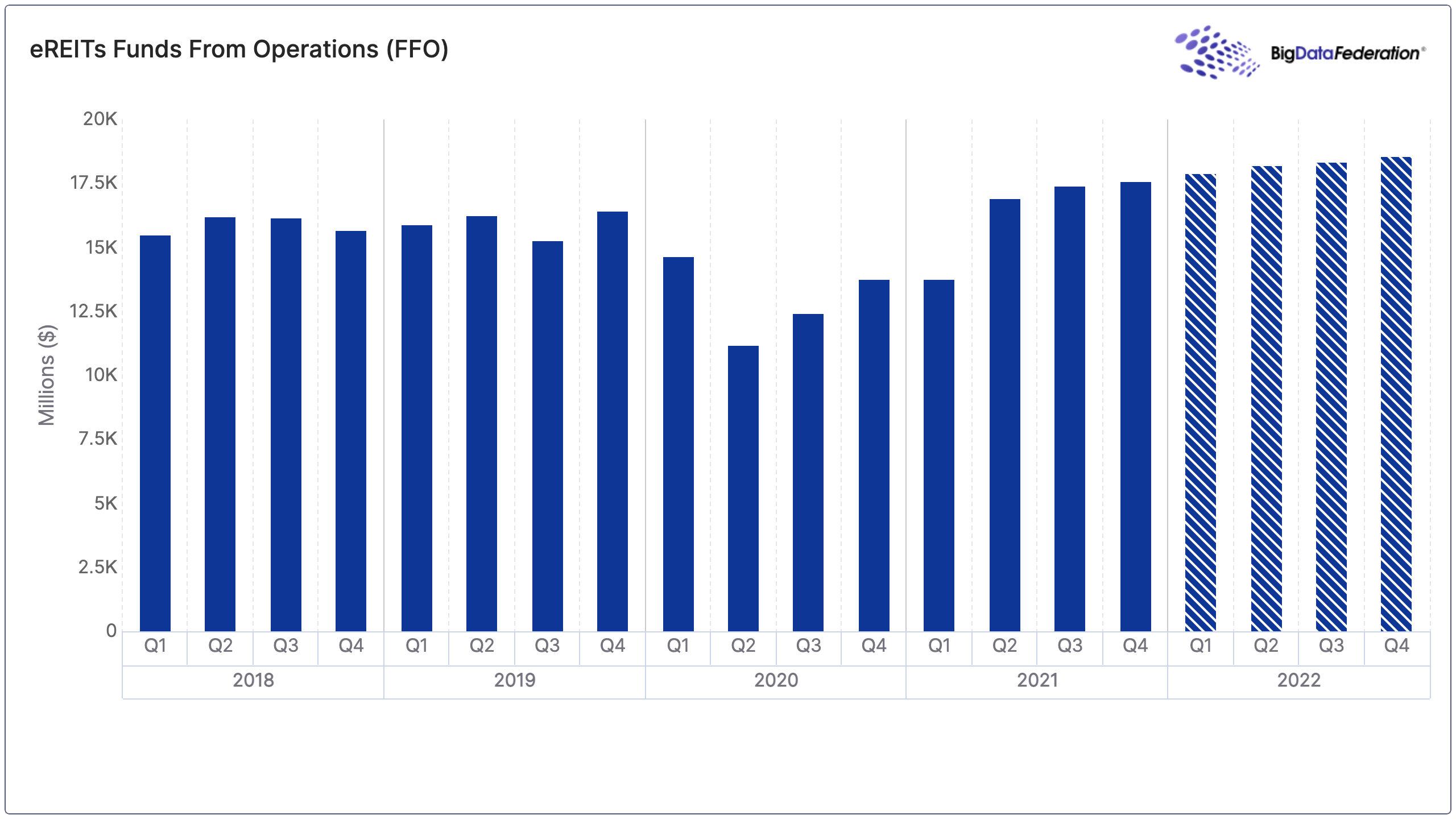
In 2020, slow growth for eREITs tenants negatively affected rent collections and lease demand; this resulted in shrunken occupancy (-3% YoY) and a slowdown in commercial property construction (-7% YoY). eREITs operating in sectors hardest hit by the pandemic, such as Lodging, Retail and Diversified, bore the brunt of the impact. Lockdown measures and travel restrictions reduced demand for leisure and business travel. For safety reasons, virtual meetings were favored instead of in-person gatherings, further harming Lodging eREITs and sinking U.S. hotel occupancy -33% YoY.
At the same time, Retail eREITs faced pressure from the changing retail landscape from physical storefronts to digital commerce. Dwindling foot traffic in retail stores caused in-person retail sales to drop while zealous online shoppers propelled e-commerce sales up +32% YoY. Some brick-and-mortar retailers went bankrupt and vacated commercial spaces. Meanwhile, Diversified eREITs, which own and manage a mix of two or more property sectors —mainly a combination of Retail, Office, Residential, and Industrial — contended with challenges in the Retail, Office, and Residential sectors. Office spaces encountered weakened demand as unemployment climbed (+116% YoY) and work-from-home took over. Finally, multifamily residential areas suffered as people flooded out of the cities, and others could no longer afford rents.
On the other hand, in 2020, Industrial, Infrastructure, and Self-Storage eREITs—already positioned for long-term growth—remained sound due to pandemic-driven trends. The shift from brick-and-mortar retail to online shopping bolstered demand for warehouses and distribution centers, supporting gains for Industrial eREITs. Infrastructure eREITs specialize in properties such as telecommunication towers, wired (fiber cables), and wireless infrastructure; these eREITs capitalized on the move towards work from home, which expedited the need for high-speed Internet connectivity. While the urban to suburban migration fortified demand for personal goods storage spaces, benefitting Self-Storage eREITs.
During 1H21, eREITs FFO grew +19% YoY because of the COVID-19 vaccination rollout and the gradual reopening of the economy. Infrastructure, Self-Storage, Lodging, and Retail eREITs experienced exceptional gains. Infrastructure eREITs continued to win as heavy data usage required advancements to existing network infrastructure and additional cell towers. Moreover, the expansion of mobile broadband coverage to underserved areas and network developments for 5G further drove demand. Self-Storage eREITs remained strong as the housing boom showed no signs of cooling down, with home sales climbing +25% YoY. Lodging eREITs recovered as vaccine adoption improved consumer sentiment for travel; this reflected in a +26% YoY increase in U.S. hotel occupancy. Similarly, Retail eREITs rebounded as in-person retail sales climbed +22% YoY.
In 2H21, our algorithms forecast year-over-year FFO growth in the mid-thirties as the economy moves toward recovery. Sectors that survived the pandemic unscathed—Industrial, Infrastructure, and Self-Storage—will sustain growth; this will be driven by the same trends as before. Sectors most devastated by the pandemic—Lodging, Retail, Residential, and Office—will continue to rebound. Lodging eREITs, fortified by summer travel, will proceed to rally through the winter holiday season and receive an additional boost from the easing of international travel restrictions. Retail eREITs resurgence will be facilitated by revenge shopping and the return of the in-person shopper, especially during the winter holiday shopping season. As people move back to major urban areas, Residential eREITs will enjoy improved occupancy and higher rents. The Office eREITs comeback will arise from businesses’ efforts to bring employees back to the office. However, the emergence of Omicron in late November could potentially delay the start of in-person office work, slow the return of in-person shopping, and dampen winter travel in the last month of 2H21.
For 2022, the full recovery of the overall economy will fuel strong demand for commercial real estate, generating growth across all eREITs sectors. However, the pace of the recovery will depend on how the Omicron situation unfolds. We project year-over-year FFO growth in the low teens with the Infrastructure, Self-Storage, Retail, Lodging, and Diversified sectors at the forefront. Infrastructure eREITs advantage will stem from multiple avenues, including but not limited to the deployment of 5G by major wireless providers, the $65 billion allocated for high-speed internet access in the signed infrastructure bill, and high barriers of entry. Infrastructure eREITs retain considerable pricing power with the average lease duration beginning at ten years, establishing these eREITs as the fastest-growing sector with 5-year FFO CAGR at 18%. Meanwhile, the Self-Storage eREITs catalyst is the accelerated housing market turnover produced by the ongoing housing boom. Retail, Lodging, and Diversified eREITs—all rebounding sectors from the COVID-era—will carry gains from 2H21 into the following calendar year.
1Infrastructure, Retail, Residential, Office, Self-Storage, Health Care, Lodging, Data Centers, Timber, Specialty and Diversified
2Funds from operations (FFO) is a metric used by REITs to define the cash flow from their operations. FFO = (Net Income + Depreciation + Amortization + Losses on Property Sales) - Gains on Sales of Property - Interest Income
At the time of posting this research, certain private investment funds and/or other investment products managed and/or advised by Ultra Blue Capital, LLC (“UBC”), an investment adviser registered with the Securities and Exchange Commission and a subsidiary of Big Data Federation, Inc., were long some or all of these securities or sectors. Both before and after the posting of this Insight, without making any public or other disclosure except as may be required by applicable law, such private investment funds and/or other investment products may, at any time, buy and sell securities and instruments of the Investments discussed in this Insight article and other companies mentioned in this Insight article, based upon such factors as UBC may, in its discretion, deem relevant. Insights are for informational purposes only and not a solicitation to invest in any of the products or services provided by the adviser. Past performance is no guarantee of future returns. There is no guarantee that any trade thesis discussed herein were or will remain profitable. Any information provided is not a recommendation to invest or divest of a specific security, commodity or sector exposure.
Published by Big Data Federation · All insights · Subscribe to Insights