Lending Continues Despite Fed Actions
By Big Data Federation, Inc.

-
Bank balance sheets expanding despite Federal Reserve’s monetary policy tightening
-
So far only auto loans have been severely impacted by the rate hikes
-
Balance sheets look good but can suddenly take a turn once the Fed’s actions seep through the economy
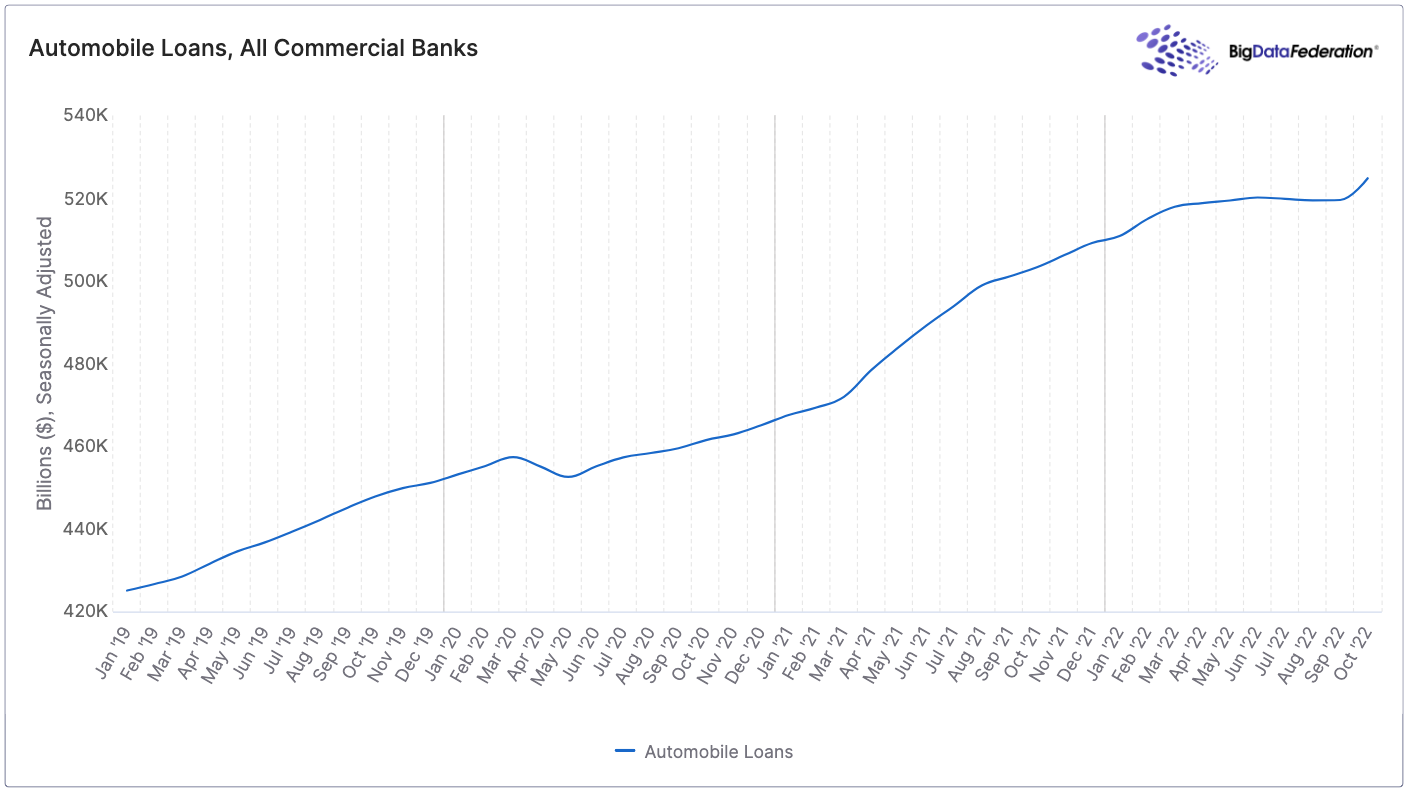
Monetary policy tightening commenced by the Federal Reserve more than six months ago, and only one sector has substantially slowed down – car loans. Other sectors have stabilized but are still expanding at a pace faster than pre-pandemic norms – most at a rate more than double that of 2019. Currently, the Federal Funds rate is 140 basis points higher than the peak in 2019; we have yet to see the full impact of the rate hikes on bank balance sheets, and a sizable slowdown looms.
While commonly said that monetary policy works with long and variable lags, the rapid response of auto loans defied this rule in the current tightening cycle. It slackened almost immediately after the initial rate increase; average month-over-month growth decelerated steadily and eventually entered negative territory. Nonetheless, it recently spiked significantly due to the acquisition of automobile loans from non-bank institutions (1% MoM/ 4% MoM/ 17% YoY3). High vehicle prices likely contributed to the swiftness with which demand declined. Payments were already unaffordable for many, and the additional financing costs pushed more out of the market.
Alternately, credit card loans maintained strength, with growth rates nearly quadruple the 2019 average (2% MoM/ 18% MoM/ 11% YoY3). Given the holiday season and ongoing revenge travel, it is unlikely to cool until after the New Year. Residential mortgages have also barely weakened since spring (1% MoM/ 8% MoM/ 7% YoY3). Initially, there was frenzied borrowing to lock in a mortgage rate before it climbed. Since then, activity has slowed but remained steady at roughly double the 2019 average, so the effect of monetary policy has a long way to go.
|
Data (October) |
MoM |
YoY |
YoY31 |
|
Auto Loans |
1% |
4% |
17% |
|
Credit Card Loans |
2% |
18% |
11% |
|
Residential Mortgages |
1% |
8% |
7% |
|
Commercial and Industrial Loans |
1% |
15% |
17% |
|
Deposits |
-1% |
1% |
36% |
|
Treasuries and Other Securities |
-2% |
0% |
46% |
|
Total Loans |
1% |
12% |
18% |
Source: Big Data Federation, Inc.
Furthermore, mortgage demand is strong enough that banks feel comfortable raising the 30-year fixed-rate mortgage. If it weakened enough to lower mortgage balances, banks would consider slightly reducing mortgage rates to attract more loans. Given moderating demand for residential properties and falling prices, mortgage balances should also experience further dramatic contraction.
While consumer loan balances show some signs of a cooldown, no similar signals appear on the commercial side. Commercial and industrial loans gained (1% MoM/ 15% MoM/ 17% YoY3) and registered blisteringly above the 2019 average. Overall, loan growth has yet to reflect the monetary tightening that has taken place. Supply of loanable funds remains plentiful despite a decline in deposits (-1% MoM/ 1% YoY/ 36% YoY3). Banks are more than willing to rebalance assets away from treasuries and other securities (-2% MoM/ 0% YoY/ 46% YoY3) towards loans (1% MoM/ 12% YoY/ 18% YoY3). As long as loan demand stays elevated, so will its growth. Unfortunately, it is unclear if it will gradually or abruptly decline to catch up with the higher interest rates.
1YoY3 = comparison with October 2019
Published by Big Data Federation · All insights · Subscribe to Insights