Rail Traffic Highlights Crossroads
By Big Data Federation, Inc.

-
Rail traffic recovered as a nationwide rail strike was averted but remained below other periods
-
Carload volume up month-over-month for all commodity groups except forest products
-
Intermodal volume is down year-over-year due to bloated retailer inventories, lower port volumes, and tight warehouse capacity
Total U.S. rail traffic recovered month-over-month as volumes previously threatened by a nationwide railroad strike improved (7% MoM/ -1% YoY/ -2% YoY3). Railroads had halted some shipments in preparation for a potential shutdown until tentative agreements brokered by the Biden administration and later signed into law narrowly averted it. Crucial to avoid further snarling supply chains and possibly exacerbating inflation more, it included roughly one-quarter percent of pay raises over five years, amongst other benefits. Rail transportation employee figures were flat but still below pre-pandemic levels (0% MoM/ 1%YoY/ -12% YoY3).
|
Data (October) |
MoM |
YoY |
YoY31 |
|
U.S. Total Rail Traffic |
7% |
-1% |
-2% |
|
U.S. Rail Transportation Employees |
0% |
1% |
-12% |
|
U.S. Carloads Traffic |
6% |
1% |
-3% |
|
U.S. Intermodal Traffic |
8% |
-2% |
-1% |
Source: Big Data Federation, Inc.
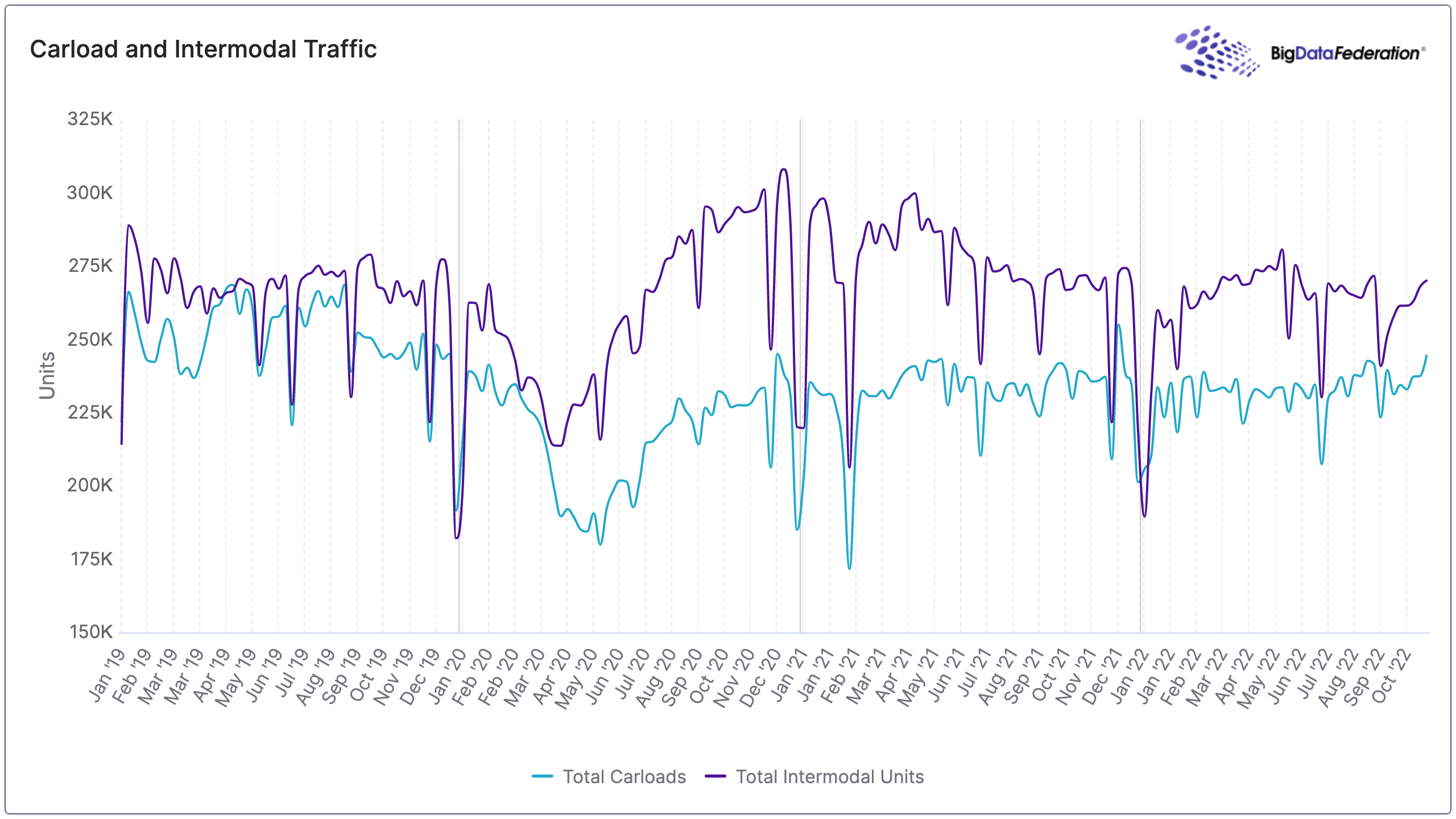
Carload units, transported solely on railroads, increased but have yet to reach pre-pandemic norms (6% MoM/ 1% YoY/ -3% YoY3). Volumes for motor vehicles and grain were significantly higher. Motor vehicles and vehicle parts volume gained from improved car production because component challenges eased. Grain volume surged as agricultural producers sought alternatives to the Mississippi River, where low water levels prohibited barge movement. Notably, forest products, which includes lumber, were the only commodity group with month-over-month declines, highlighting weakened new residential construction.
Intermodal units, which involve at least two modes of transport, also rose (8% MoM/ -2% YoY/ -1% YoY3). Year-over-year comparisons declined because of softened consumer demand; retailer inventories remained bloated, port volumes lowered, and warehouse capacity stayed tight. Ship containers transported on rail flatcars – roughly ninety percent of the total – were stable, while truck trailers moved on rail flatcars decreased. Additionally, overwhelmed landside operations have seen excess inventory stored in ship containers and truck trailers outside warehouses and stores due to limited space in distribution centers. Albeit viewed as a short-term solution, it creates a mobile warehouse and keeps logistics nimble amid the uncertain economic environment.
1YoY3 = comparison with October 2019
Published by Big Data Federation · All insights · Subscribe to Insights