Healthcare’s Checkup
By Big Data Federation, Inc.

-
Healthcare spending, roughly a quarter of consumer expenditures on services, rose
-
Hospitals continued to shift away from inpatient to outpatient volumes
-
Wage gains slowed because of a shift from expensive contract labor
With the pandemic firmly in the rearview mirror, healthcare had a more stable start to the year. Healthcare spending, which accounts for roughly one-quarter of consumer expenditures on services, rose (1% MoM/ 6% YoY/ 18% YoY4). Demand recovered moderately, but associated prices climbed.
Hospital utilization was flat (0% MoM/ - 8% YoY), while year-over-year comparisons dropped in line with lower cases of respiratory illnesses like COVID and flu. More significantly, hospitals continued to move from inpatient to outpatient volumes, including in surgical settings where elective procedures picked up, as evidenced by higher operating room minutes. Hospitals’ inpatient revenue recovered (2% MoM/ -1% YoY), and outpatient revenue showed sustained growth (2% MoM/ 18% YoY).
|
Data (January) |
MoM |
YoY |
YoY4 |
|
Healthcare: Consumer Expenditures |
1% |
6% |
18% |
|
Hospitals: Utilization |
0% |
-8% |
N/A |
|
Hospitals: Inpatient Revenue |
2% |
-1% |
N/A |
|
Hospitals: Outpatient Revenue |
2% |
18% |
N/A |
|
Healthcare: Employees |
0% |
4% |
3% |
|
Healthcare: Payrolls |
1% |
8% |
24% |
Source: Big Data Federation, Inc.
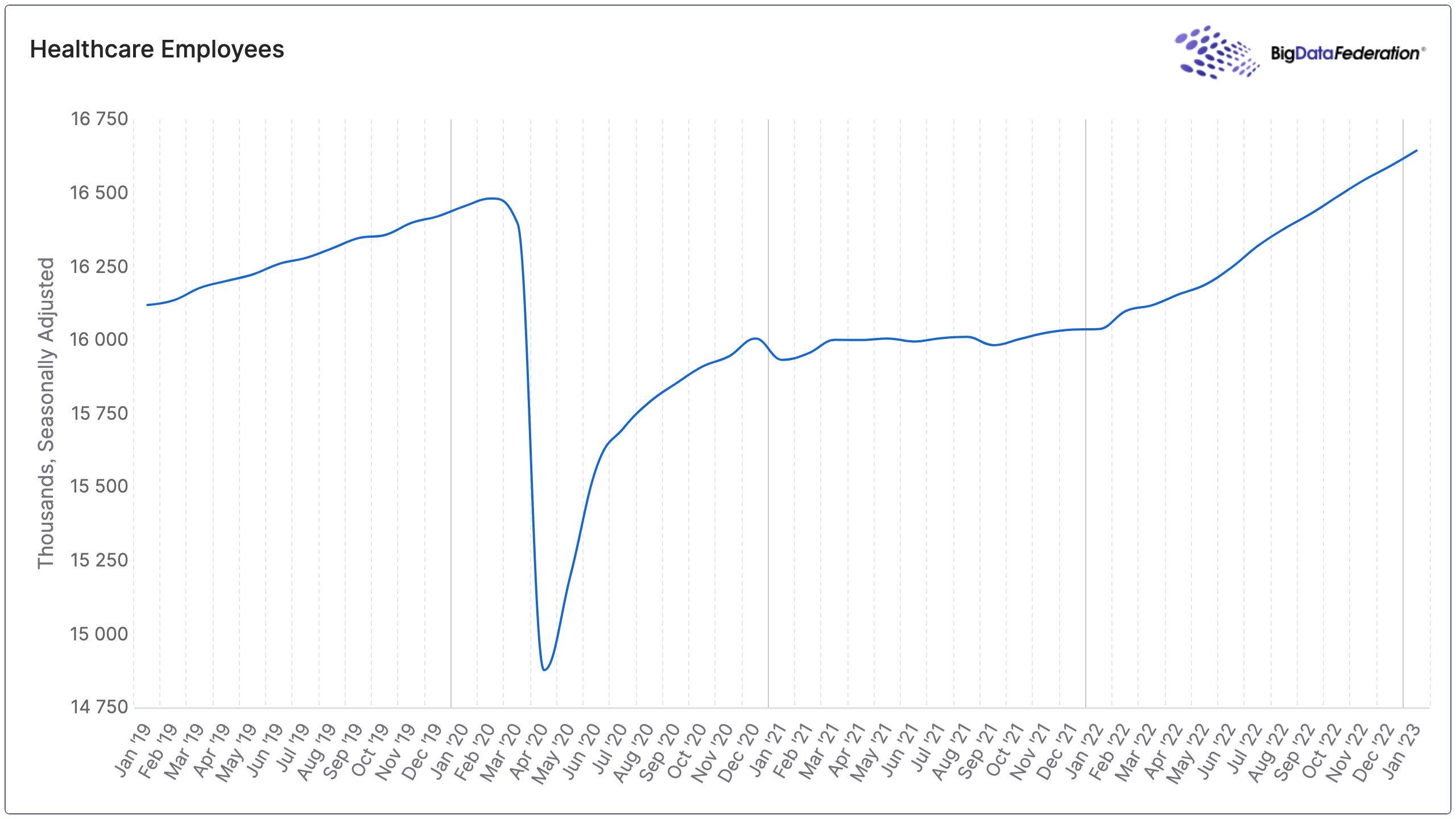
Healthcare prices, measured through the personal consumption expenditures price index (PCE) and the consumer price index (CPI), increased. Notably, the two main price indexes that measure inflation calculate it differently. Also, it comprises a larger share in the former, making PCE more sensitive to upward pricing pressures. While drug-related expenses have declined and supply costs have cooled, labor remains an issue. Healthcare employment recovered to pre-pandemic levels late last year (0% MoM/ 4% YoY/ 3% YoY4), yet there are still shortages in particular subsectors, such as nursing homes. Wage gains slowed because of a shift from expensive contract labor, but pressures remain (1% MoM / 8% YoY/ 24% YoY4).
Published by Big Data Federation · All insights · Subscribe to Insights