Spring in the Housing Market’s Step
By Big Data Federation, Inc.

-
Sales of existing homes rose in line with seasonal patterns
-
Expectations are that mortgage rates have peaked amidst the busy spring season
-
Buyers are highly rate sensitive and may respond more positively due to pent-up demand
Mortgage rates have been on a roller coaster in response to economic data. Ultimately, the fixed rate for a 30-year mortgage contract ended last month above other periods (2% MoM/ 170% YoY). Higher mortgage rates raised the average loan amount to purchase homes, although there is some reprieve year-over-year (4% MoM/ -5% YoY). Climbing median sales prices for pre-owned (1% MoM/ 0% YoY) and new (3% MoM/ 3% YoY) homes were another factor that contributed to larger loans.
|
Data (February) |
MoM |
YoY |
YoY4 |
|
30-Year Fixed-Rate Mortgage (FRM) |
2% |
170% |
46% |
|
Purchase: Mortgage Loan Amounts |
4% |
-5% |
34% |
|
Existing Homes: Median Sales Price |
1% |
0% |
NA |
|
New Homes: Median Sales Price |
3% |
3% |
37% |
|
Purchase: Mortgage Loan Applications |
-13% |
-38% |
-32% |
|
Existing Homes: Sales |
14% |
-23% |
NA |
|
New Homes: Sales |
1% |
-19% |
0% |
Source: Big Data Federation, Inc.
Higher mortgage rates also weighed on potential buyers, which led to a decrease in mortgage applications to purchase homes (-13% MoM/ -38% YoY). Nonetheless, sales counts for existing homes (14% MoM/ -23% YoY%), based on closings, improved in line with seasonal patterns after twelve months of declines; contracts, likely signed at the end of December and throughout January, benefitted further from the lower mortgage rates at that time. Similarly, new home sales also gained from the same pattern (1% MoM/ -19% YoY).
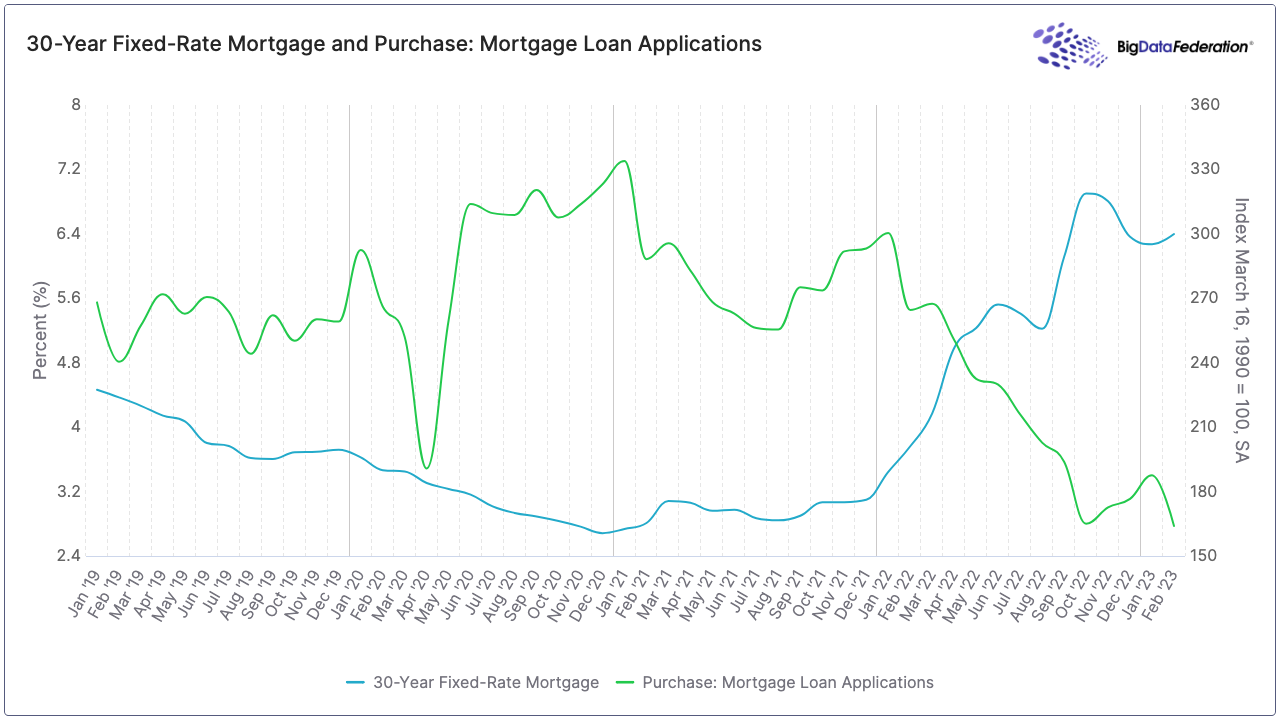
Expectations are that mortgage rates have peaked, and recent instability in the banking system puts further downward pressure. Fluctuations are more consequential in the spring because about two-fifths of existing-home sales occur from March through June. It is clear buyers are highly rate sensitive and may respond more positively due to pent-up demand.
Published by Big Data Federation · All insights · Subscribe to Insights