Trucking Turns a Corner
By Big Data Federation, Inc.

-
U.S.-bound truck crossings fell at both international land borders
-
Supply increased as record numbers of small new fleet operators entered in the past couple of years
-
Oversupply triggered a drop in spot rates; contract rates will gradually adjust
Amidst the current inventory destocking, freight volumes have tumbled on all transportation modes. Freight-related expenses fell across the sector as both load counts and rates decreased. For instance, declines in loaded import containers at ports affect trucking and rail demand; most goods reach their destination via intermodal transportation. U.S.-bound truck crossings fell at both international land borders. Mexico-U.S. crossings (-5% MoM / -2% YoY / 119% YoY3) performed better when compared to Canada-U.S. crossings (-14% MoM / -8% YoY / 95% YoY3). Last year, nearly one-third of truck crossings on the southern border contained fruits and vegetables, one-half times the previous decade.
|
Data (December) |
MoM |
YoY |
YoY31 |
|
Mexico–U.S. Truck Crossings |
-5% |
-2% |
119% |
|
Canada–U.S. Truck Crossings |
-14% |
-8% |
95% |
|
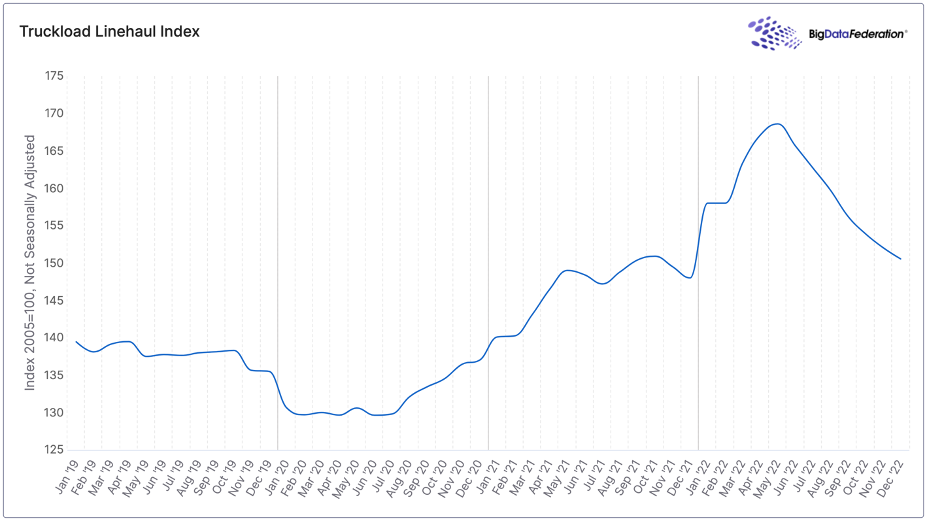
Truckload Linehaul Index |
-1% |
2% |
11% |
Source: Big Data Federation, Inc.
Increased supply further exacerbated matters in the trucking industry, as record numbers of small new fleet operators, including owner-operators, entered in the past couple of years. Small trucking carriers that typically have significant spot market exposure are more vulnerable than large carriers. Fewer truckload opportunities resulted in oversupply and drove down rates, especially in the spot market. Larger carriers benefitted from negotiated contracts; contract rates are usually higher than spot rates and adjust gradually. Per-mile truckload linehaul rates, separate from added costs such as fuel and accessorial to reflect baseline trends, dropped (-1% MoM / 2% YoY / 11% YoY3).
The pandemic forced trucking companies to navigate strong demand in the face of dramatically higher costs for fuel, maintenance, equipment parts, and wages. Further innovations are in store to adjust to the expected fluctuations in the volatile market, with the industry aiming to take a more balanced and data-driven approach moving forward. Key themes include better coordination with shippers, railroaders, and freight brokers to reduce terminal dwell times, decrease empty miles, and improve fuel economy. These new strategies should forge a path ahead to maximize utilization.
1YoY3 = comparison with December 2019
Published by Big Data Federation · All insights · Subscribe to Insights