Trade Balance to Boost GDP Growth
By Big Data Federation, Inc.

-
Trade balance and inventory adjustments have played significant roles in dragging down otherwise positive GDP growth in previous quarters
-
Turnabouts of the two biggest drags on GDP in the first half will likely lead to positive GDP growth in 3Q22
-
As consumers return to pre-pandemic patterns and supply chain issues settle, GDP growth should remain in the mildly positive territory moving forward
Over the last two quarters, a noteworthy trend has developed where the national gross domestic product (GDP) contracted, but the rest of the economy, particularly unemployment, showed no signs of a recession. The trade balance and inventory adjustments have played an important role in dragging down otherwise positive GDP growth. For the third quarter, neither the trade balance nor inventories appear to weigh on GDP.
2022 so far
In the first quarter, the worsening trade balance pressured GDP growth into negative territory by roughly three percentage points. Considering the overall figure was -1.6% QoQ, had the trade balance stagnated, it would have registered a positive number.
In the second quarter, slowdowns in inventory investment dragged down GDP growth by around two percentage points. Similarly, had inventories stayed flat, economic growth would have been positive since it lodged -0.6% QoQ. Excess inventory build-up led to inventory shedding, particularly for goods no longer in demand, such as lounge wear, small household appliances, and patio furniture.
|
Contribution to GDP Growth |
2019 |
2020 |
2021 |
1Q22 |
2Q22 |
|
Goods Consumption |
+0.66 |
+1.07 |
+2.72 |
-0.02 |
-0.61 |
|
Services Consumption |
+0.69 |
-3.08 |
+2.83 |
+0.93 |
+1.99 |
|
Investment exl. Inventories |
+0.49 |
-0.40 |
+1.30 |
+0.83 |
-0.92 |
|
Change in Private Inventories |
+0.05 |
-0.55 |
+0.24 |
+0.15 |
-1.91 |
|
Trade Balance |
-0.11 |
-0.26 |
-1.25 |
-3.13 |
+1.16 |
|
Government |
+0.58 |
+0.45 |
+0.11 |
-0.40 |
-0.29 |
|
Total GDP Growth |
+2.3 |
-2.8 |
+5.9 |
-1.6 |
-0.6 |
Source: Big Data Federation, Inc.
During 3Q22, the trade balance built on improvements it made the previous quarter (around one percentage point). The trade deficit became less negative, shrinking -12% MoM in July and another -4% MoM in August. Combined with an expected improvement in September, net exports will be significantly smaller than the previous quarter, translating to a positive contribution to GDP growth.
Inventory shedding has also reversed in 3Q22, businesses' inflation-adjusted inventories increased +1% MoM and +2% MoM in July and August, respectively. Inventories will continue to climb as retailers prepare for the upcoming holiday season (Halloween, Thanksgiving, and Christmas). Turnabouts of the two biggest drags on GDP in the first half will likely lead to positive GDP growth in 3Q22.
Beyond 3Q22
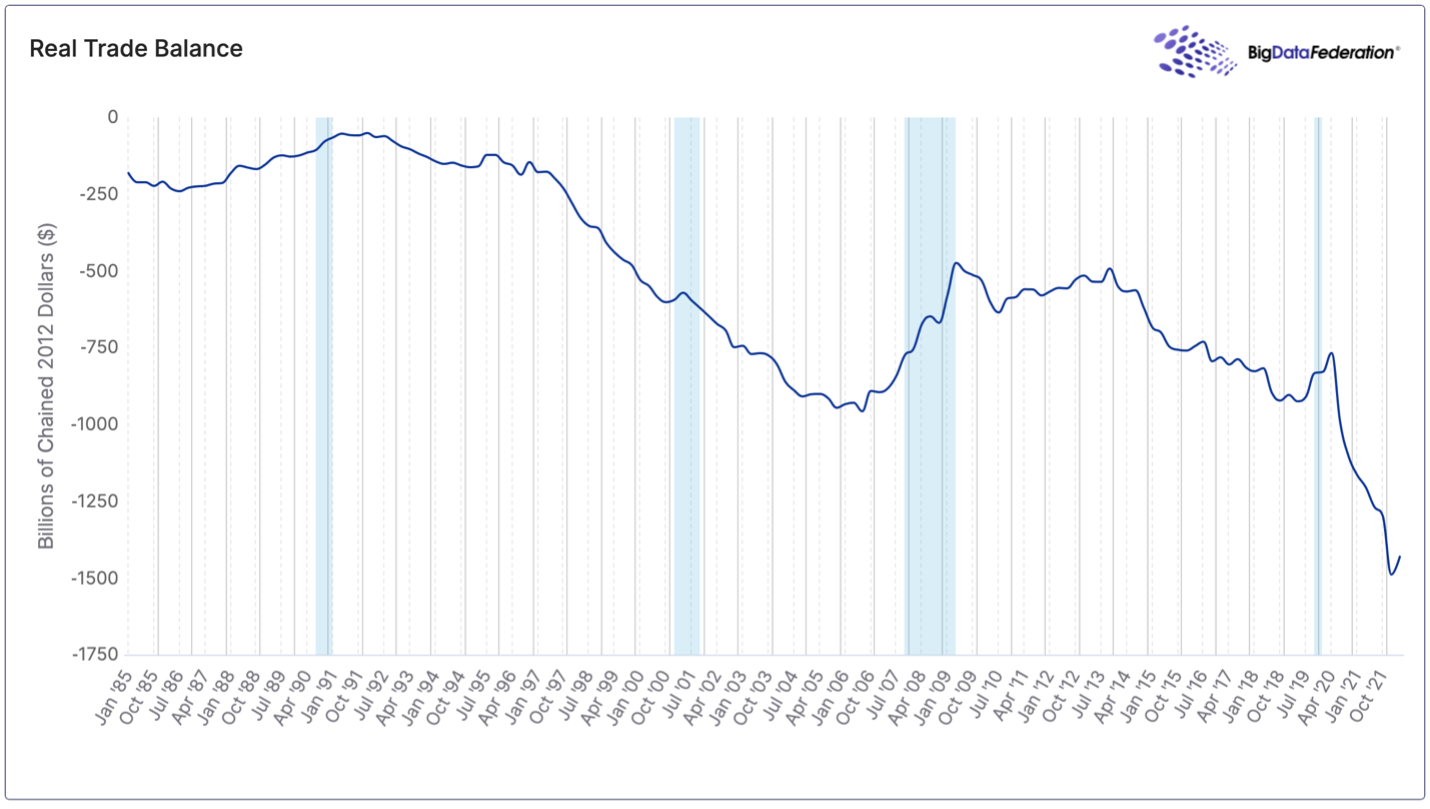
Easing of the dramatic deterioration in the trade balance – triggered by the coronavirus – should bolster GDP growth. Elevated goods demand during COVID lockdowns negatively affected the trade deficit as most goods are imports into the U.S. As consumer preferences revert to pre-pandemic patterns, imports will decrease, and the trade deficit will reap the benefits. Consumer goods imports have already begun to decline and still have room to fall to historical norms. Once imports decline, the trade balance will recoup, all else equal. But we know all else is not equal because many changes are occurring in the global economy.
While there is discussion that the trade deficit will intensify because of the strong dollar, in practice, this mechanism is messy. In theory, an appreciating greenback turns imports cheaper for domestic consumers and exports more expensive for foreigners. As such, imports should rise, and exports should fall, leading to a worsening trade balance. However, past correlation between the dollar index and the trade balance is weakly positive (around 0.3), implying other factors override the theoretical relationship.
A closely related thesis is that the world will enter a recession more severe than the one in the United States; therefore, the rest of the world will cut back on consumption of U.S. exports more than the U.S. will cut back on imports from the rest of the world. It should lead to an increasingly negative trade balance for the U.S., but former global recessions demonstrate this has not always been the case. During the Great Recession, U.S. growth declined, but several G7/developed economies were worse off. Instead, the trade balance recovered by over half at the recession end. It is not necessarily true that a global recession will burden the trade balance.
During the Great Recession, as the trade balance improved, it added up to seven percentage points to GDP growth over the year-and-a-half period. If the current balance rebounds to pre-pandemic levels, a similar if not larger boost is expected to economic growth throughout the year. This boost will help keep GDP growth in the mildly positive territory. Additionally, as supply chain issues settle, inventories will normalize and not fluctuate as dramatically.
Published by Big Data Federation · All insights · Subscribe to Insights