Stay Calm: No Recession in Sight
By Big Data Federation, Inc.

While the market has reacted with volatility to recession concerns, we believe these market fluctuations are primarily driven by investor sentiment and technical trading rather than underlying economic weaknesses.
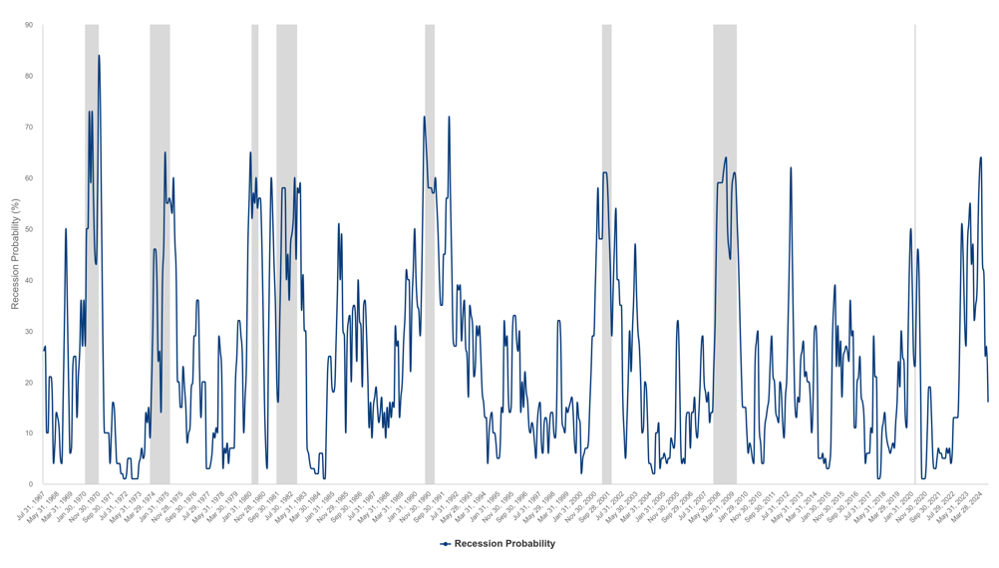
Our proprietary real-time econometric model, using a broad set of US economic indicators, does not forecast a recession in the next six months. Our analysis is based on the fundamentals of the economy, and we do not see a fundamental recession based on employment, retail sales, consumer sentiment, purchasing managers surveys, bank loans, and more. We ensemble several models including unsupervised machine learning and generalized linear models. Our current recession probability in the next six months lies around 16%, the lowest in two years.
Consumer spending measures, including Real Personal Consumption Expenditures and Advanced Retail Sales in Retail Trade and Food Services, demonstrate steady growth albeit at a reduced pace. It reflects cautious consumer behavior amidst economic uncertainties, higher interest rates, and inflation. Nonetheless, the stability in consumer spending proves a resilient consumer despite their pessimistic outlook.
Business spending indicators, such as Merchant Wholesalers' Sales, Industrial Production: Total Index, as well as Loans and Leases, show mixed signals. Merchant wholesalers' sales have been inconsistent, and industrial production has shown fluctuations but reflects a positive trend in output. Loans and leases have climbed steadily reflecting that banks are maintaining their lending activities. Positive but modest trajectories indicate a cautious yet stable business investment environment.
Inflation metrics, including the Producer Price Index (PPI) and Consumer Price Index (CPI), suggest that inflationary pressures are easing. Moderation in inflation at the producer’s level, can be beneficial for consumers, and as CPI continues to stabilize, it contributes positively to the economic outlook. Although, this is not to say the road down may be bumpy. Other measures used by the NBER, such as Real Personal Income Excluding Current Transfer Receipts and Real Final Sales of Domestic Product also display moderate growth.
Employment metrics, such as All Employees, Total Nonfarm and Employment Level, have shown a slowdown in job gains in recent months. Although the employment level remains high, the increase in the unemployment rate suggests potential softness in the labor market. High interest rates and inflationary pressures are contributing to the deceleration, where businesses are exercising caution on hiring and investment behaviors. While the labor market's strength is not as robust as it once was, it does not yet indicate a significant downturn.
The U.S. still holds one of the lowest unemployment rates amongst the largest economies.
|
Country |
Latest Unemployment Rate |
|
United States |
4.30% |
|
China |
5.20% |
|
Japan |
2.50% |
|
Germany |
3.00% |
|
India |
7.60% |
|
United Kingdom |
4.20% |
|
France |
7.10% |
|
Italy |
7.90% |
|
Brazil |
8.40% |
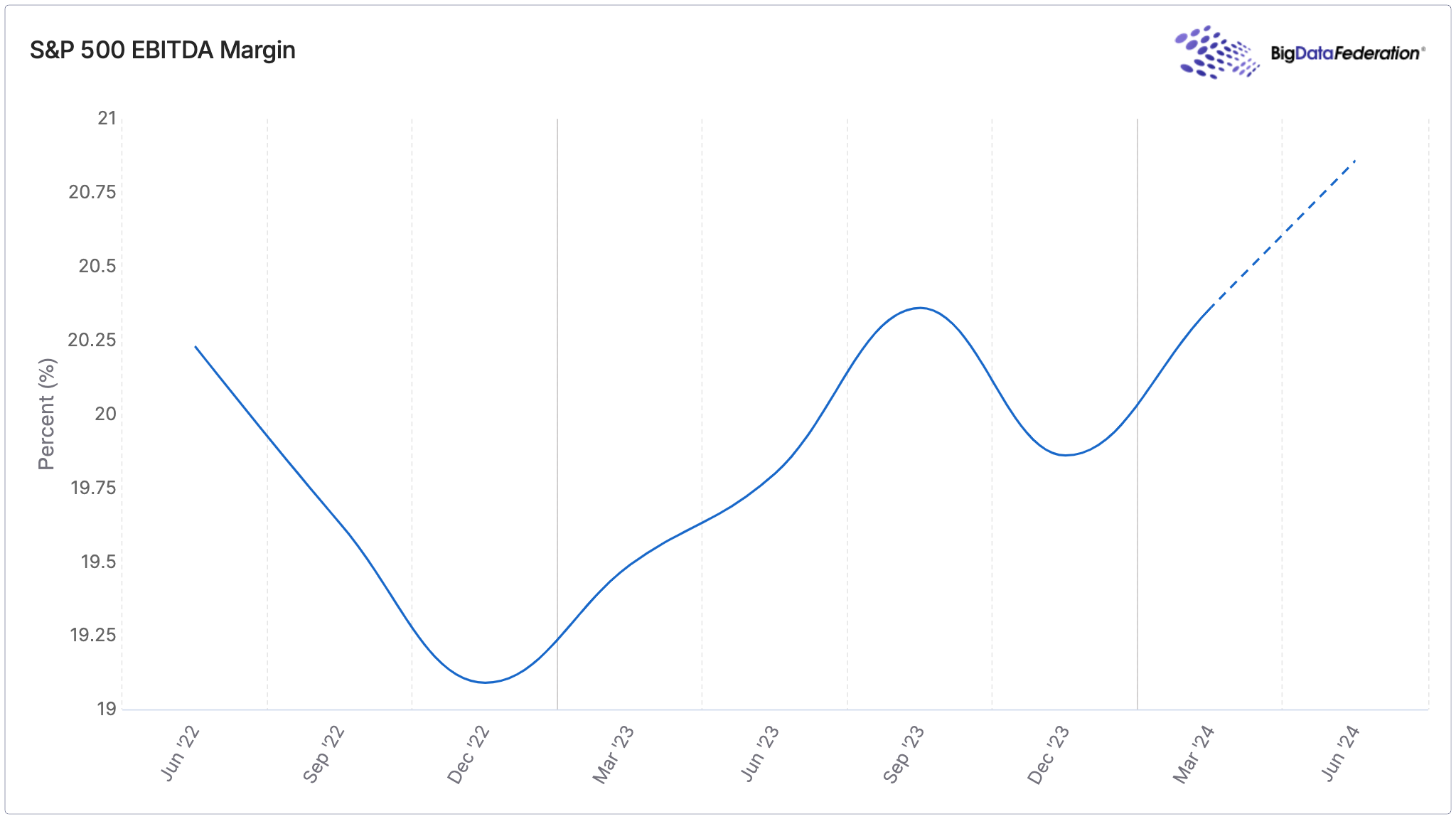
Furthermore, our machines predict that earnings growth for the S&P 500 remains robust. In the chart below, we present our forecast for the S&P 500’s EBITDA margin, which is trending upwards.
The global asset markets (such as equities, commodities, and currencies) are littered with all sorts of liquid exotic complex depravities. Hence, fear or greed could cause markets to undershoot or overshoot more violently than ever before. However, data support a narrative of cautious optimism. While no one can determine what the future holds, it is hard to make a case for a recession. While market volatility may persist, continuous monitoring of these trends and broader economic indicators will be essential to assess the total economic outlook.
Published by Big Data Federation · All insights · Subscribe to Insights