Silicon Valley: Engine of Growth
By Big Data Federation, Inc.

Are you betting too much on Silicon Valley? Many US equity investors are unwittingly heavily exposed to Silicon Valley companies, either directly or indirectly. The dominance of these companies in the S&P 500 has been both a boon and a source of anxiety for the market. While it's no secret that Silicon Valley giants have significantly contributed to the S&P 500's return performance, their contributions to the market’s fundamentals are simply underappreciated.
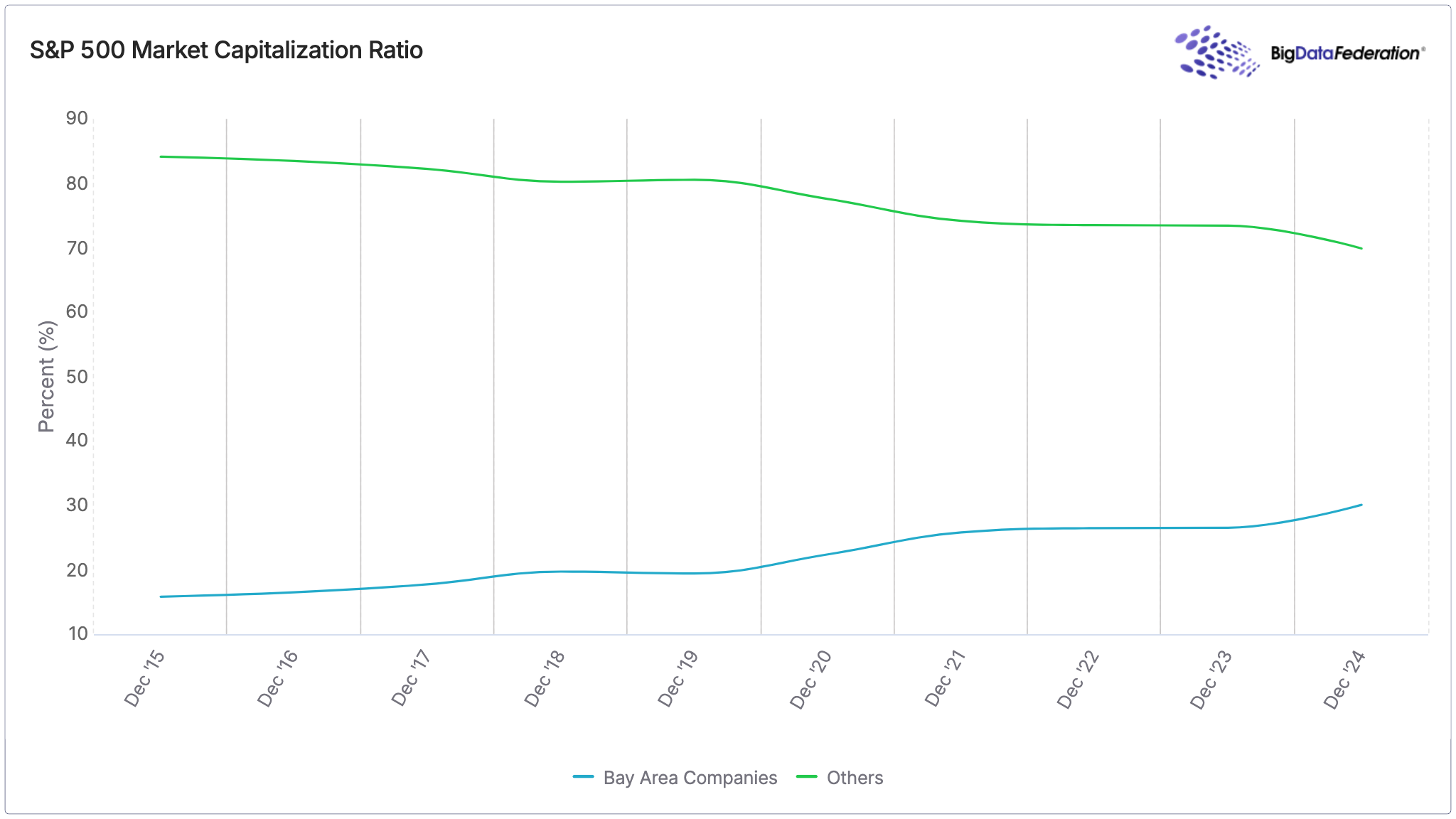
Currently, San Francisco Bay Area1 giants account for a staggering 30% of the S&P 500’s total market cap – triple their proportional representation in terms of company count. Notably, this figure excludes Microsoft (MSFT) and Amazon (AMZN), which are not headquartered in the Bay Area. While Wall Street serves as the global financial epicenter, Wall Street-based2 companies account for less than 6% of the S&P 500 index’s total market capitalization. Throughout this article, Bay Area and Silicon Valley are used interchangeably, as are New York and Wall Street.
Historical evidence paints a consistent picture: Silicon Valley’s influence is on the rise. Analysis of just-in-time S&P 500 constituents reveals a long-standing trend that has been brewing for years. If this trajectory continues, Bay Area companies could comprise over 50% of the S&P 500 market capitalization within a decade.
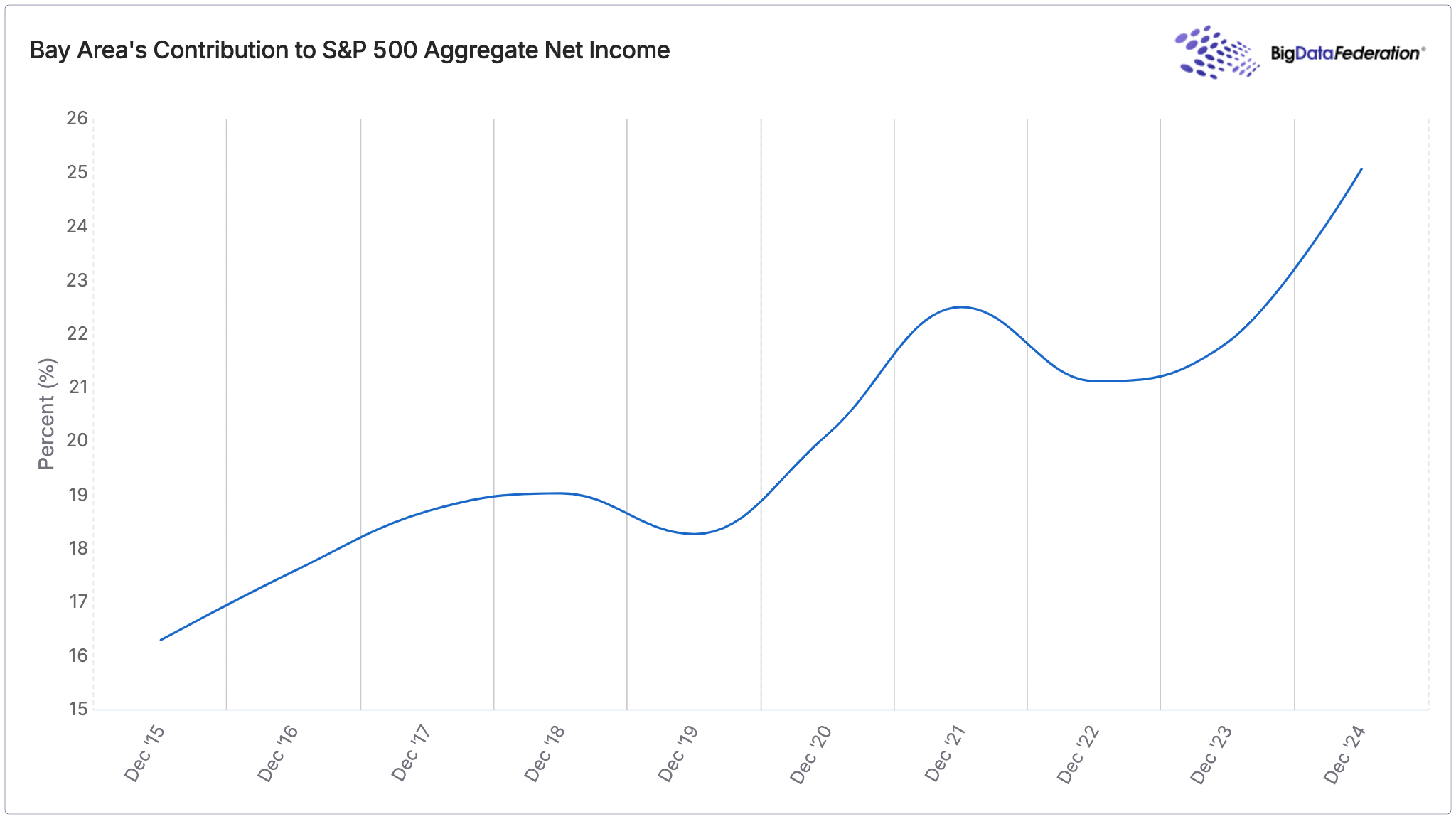
Is this concentration justifiable, or should investors curb their enthusiasm? Here, we will use mass data aggregation of point-in-time information to investigate the contribution of Silicon Valley's corporations to the S&P 500 index's fundamentals. Our analysis of the fundamentals reveals the growing influence of Silicon Valley companies on the index's overall performance. It turns out that Bay Area companies are increasingly capturing a larger share of the total S&P 500 earnings.
Not only is this trend of Silicon Valley companies accounting for an accelerating growth share evident in earnings, but we also see similar patterns across other key fundamental metrics such as revenue and earnings before interest, tax, and depreciation (EBITDA). Overall, Silicon Valley companies contributed six times more to revenue growth than Wall Street enterprises, on average. Similarly, with EBITDA, Silicon Valley companies consistently posted positive figures, even during the broader decline of 2020, thus contributing 100% to the growth. In years with positive growth, Silicon Valley companies contributed ten times more to EBITDA growth than Wall Street companies, on average. Interestingly, Bay Area companies are at record levels for earnings growth contribution.
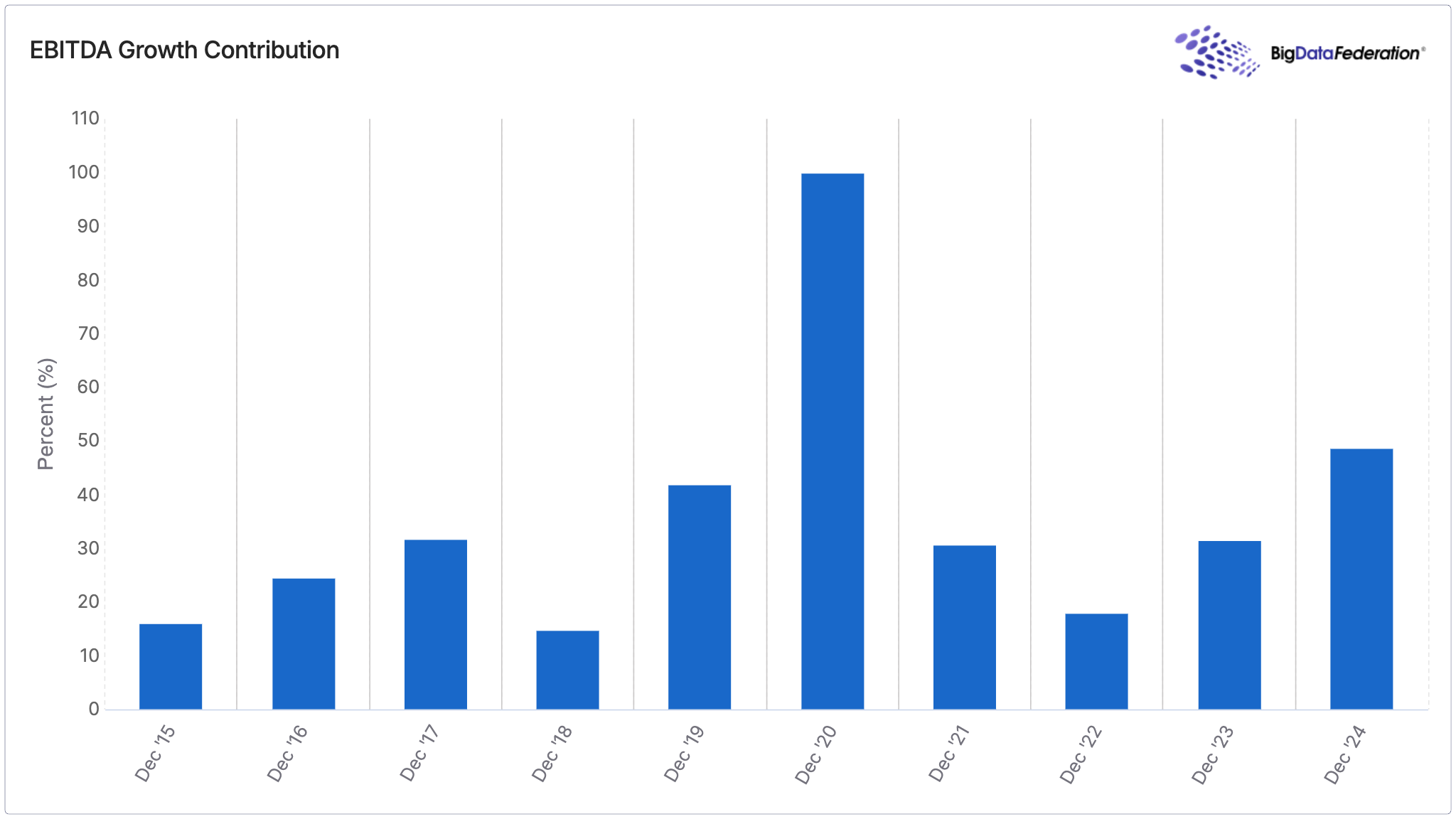
Silicon Valley firms not only wield an outsized market cap disproportionate to their number of tickers compared to Wall Street, but this disparity becomes even more stark in terms of revenue and EBITDA growth contributions, emphasizing their substantial impact. It appears the returns reflect the underlying fundamentals, suggesting their dominance might indeed be justified.
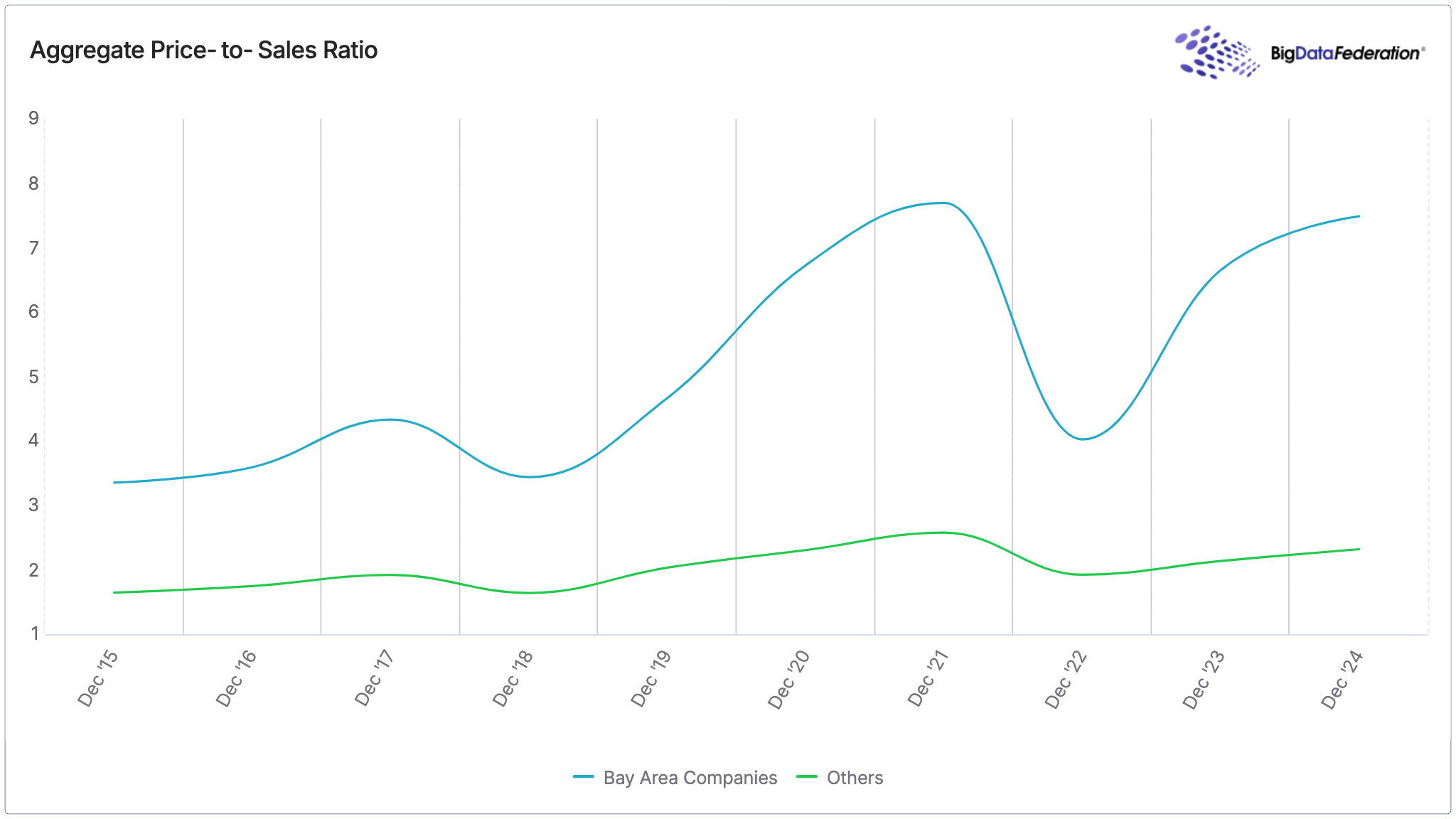
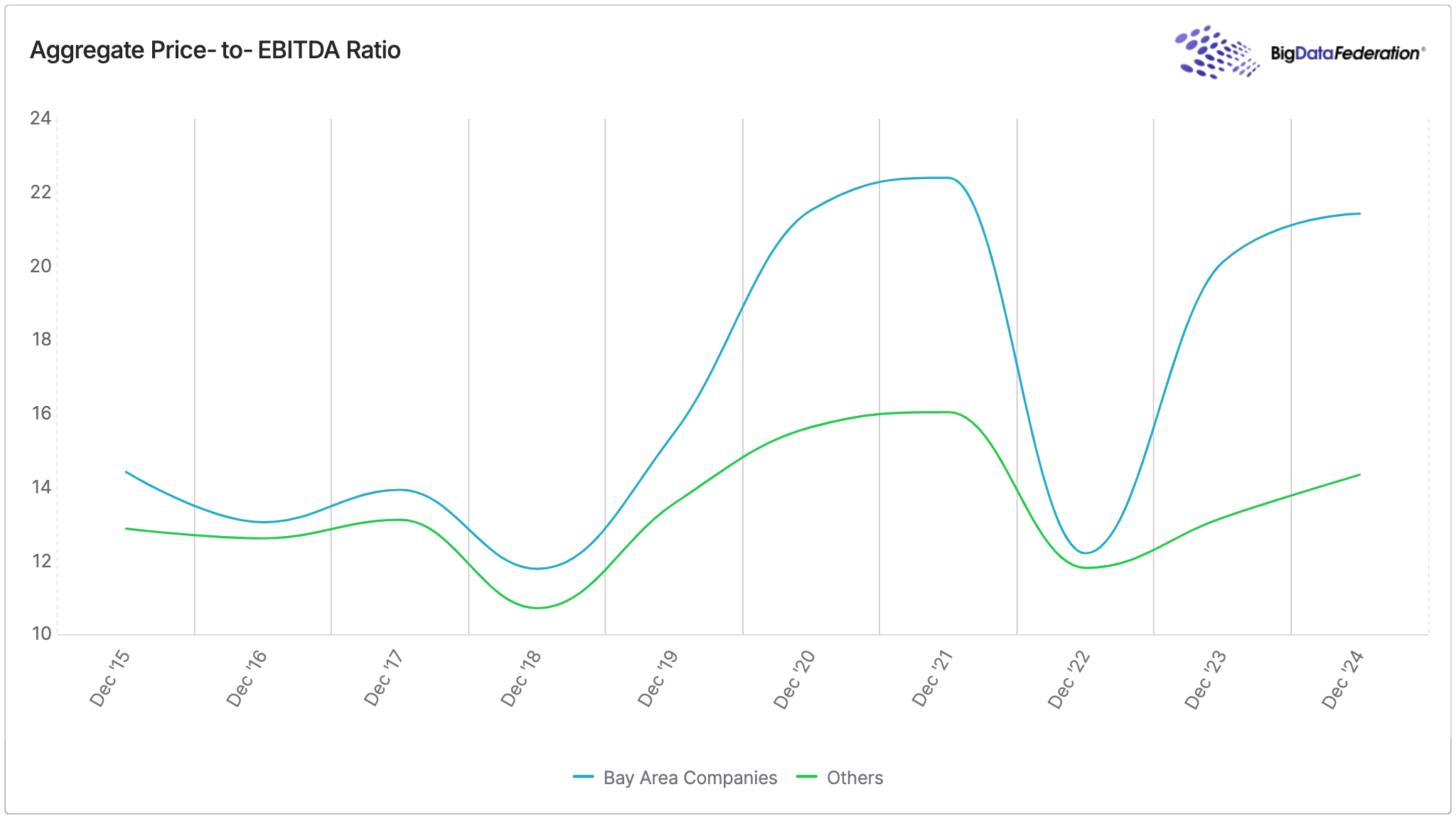
Now we come to the question of valuation. Wall Street has long pitted companies against each other in two categories: growth and value. However, what is considered expensive today may well be cheap in the future if the fundamentals continue to grow robustly. Silicon Valley companies, with their consistent track record of EBITDA growth, even during broader market declines, exemplify this potential. In 2022, fears of a looming recession triggered a widespread reset of valuations, causing them to sharply disconnect from underlying fundamentals. Since then, the valuation metrics of Bay Area companies have normalized, which are backed by accelerating fundamentals.
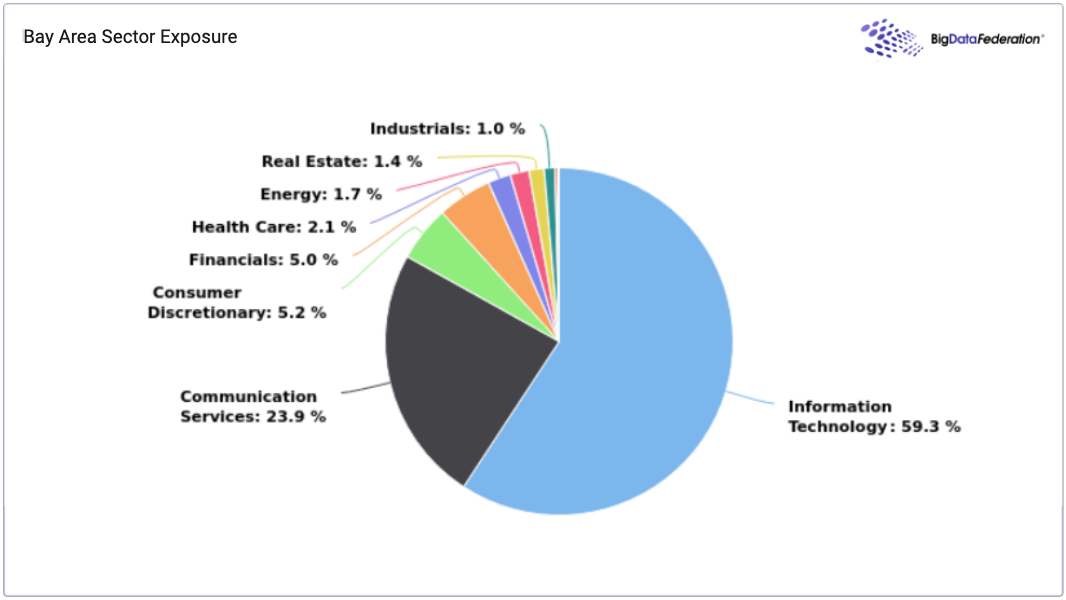
Contrary to popular belief, the Bay Area is not just a tech hub; it is diverse. Ten out of the eleven Global Industry Classification Standard (GICS) sectors have a presence in the region, showcasing its broad economic base. This diversity underpins the area's robust economic framework, reflecting its capacity to influence a wide array of industries.
How is such an impact possible from a region that accounts for only 2% of the U.S. population? What makes them so different? Perhaps it's something in the water—or more likely, it's the region's distinctive mix of innovation and entrepreneurship that continues to push the boundaries. Big tech companies, in particular, not only have global reach but have also mastered the art of building scalable businesses efficiently. Current advancements in AI, for example, position them uniquely to spearhead and continuously reshape the global digital transformation.
In conclusion, our analysis paints a vivid picture of how Bay Area companies have significantly bolstered the S&P 500's return performance and fundamental metrics. With an outsized contribution to revenue and EBITDA growth, alongside substantial market cap proportions, Silicon Valley has played an integral role in driving the index's performance over the past decade – a trend that shows no sign of slowing.
Note: 2024 as of Aug 20, 2024
1 Defined as tickers with headquarters in Marin, Sonoma, Napa, Solano, San Francisco, San Mateo, Contra Costa, Alameda, and Santa Clara.
List: Airbnb Inc Cl A (ABNB), Super Micro Computer Inc Com (SMCI), Cooper Companies Inc Com (COO), Intuitive Surgical Inc Com (ISRG), Fortinet Inc Com (FTNT), Arista Networks Inc Com (ANET), Advanced Micro Devices Inc Com (AMD), Broadcom Inc Com (AVGO), Keysight Technologies Inc Com (KEYS), Applied Materials Inc Com (AMAT), Robert Half International, Inc. (RHI), Nektar Therapeutics (NKTR), Synopsys (Synopsis) Inc Com (SNPS), Sanmina Corporation (SANM), Netapp Inc Com (NTAP), Autodesk Inc Com (ADSK), Adobe Inc Com (ADBE), Nvidia Corp Com (NVDA), Salesforce Inc Com (CRM), Gap Inc (GPS), Tesla Inc Com (TSLA), Bio Rad Labs Inc Cl A Com (BIO), Agilent Technologies Inc Com (A), Franklin Resources Inc Com (BEN), Pagerduty Inc (PD), Lam Research Corp Com (LRCX), Kla (Tencor) Corp Com (KLAC), Netflix Inc Com (NFLX), Pg&E Corp Com (PCG), Alphabet Inc Cl A (GOOGL), Visa Inc Cl A (V), Paypal Holdings Inc Com (PYPL), Intuit Inc Com (INTU), Ebay Inc Com (EBAY), Wells Fargo & Co Com (WFC), Gilead Sciences Inc Com (GILD), Palo Alto Networks Inc Com (PANW), SentinelOne Inc (S), Prologis Inc Com (PLD), Cadence Design System Inc Com (CDNS), Hp Inc Com (HPQ), Enphase Energy Inc Com (ENPH), Apple Inc Com (AAPL), Juniper Networks Inc Com (JNPR), Essex Property Trust Inc Com (ESS), Meta Platforms Inc Cl A (META), Service Now Inc Com (NOW), Intel Corp Com (INTC), Uber Technologies Inc Com (UBER), Western Digital Corp Com (WDC), Chevron Corp Com (CVX), Equinix Inc Com (EQIX), Electronic Arts Inc Com (EA), Clorox Co Com (CLX), Cisco Systems Inc Com (CSCO), Ross Stores Inc Com (ROST)
2 Defined as tickers headquartered in the City of New York
List: Blackrock Inc Cl A (BLK), Kkr & Co Inc Com (KKR), Morgan Stanley Com (MS), Consolidated Edison Inc Com (ED), Foot Locker Inc (FL), Nasdaq Inc Com (NDAQ), American International Group Com (AIG), Colgate Palmolive Co Com (CL), Blackstone Inc Com (BX), PVH Corp (PVH), Citigroup Inc Com (C), Marketaxess Holdings Inc Com (MKTX), Loews Corp Com (L), Pfizer Inc Com (PFE), Bank Of New York Mellon Corp Com (BK), Goldman Sachs Group Inc Com (GS), Marsh & Mclennan Cos Inc Com (MMC), Metlife Inc Com (MET), Omnicom Group Inc Com (OMC), Interpublic Group Of Cos Com (IPG), Coty Inc (COTY), Vornado Realty Trust (VNO), SL Green Realty Corp (SLG), International Flavors & Fragran Com (IFF), American Express Co Com (AXP), Verizon Communications Inc Com (VZ), Paramount Global Cl B (PARA), Msci Inc Cl A (MSCI), Ralph Lauren Corp Cl A (RL), Fox Corp Cl A (FOXA), Jpmorgan Chase & Co Com (JPM), Estee Lauder Companies Inc Cl A (EL), Hess Corp Com (HES), New York Times Co (NYT), Moodys Corp Com (MCO), Vici Properties Inc Com (VICI), S&P Global Inc Com (SPGI), Warner Bros Discovery Inc Cl A (WBD), Tapestry Inc Com (TPR), News Corp Cl A Non Vtg (NWSA), Macy's Inc (M), Jefferies Financial Group Inc (JEF), Take Two Interactive Software Com (TTWO)
Published by Big Data Federation · All insights · Subscribe to Insights