Open Road for Natural Gas Transportation Sector
By Big Data Federation, Inc.

-
Export volumes climb steadily creating further opportunities for pipeline operators.
-
Recent tailwinds include elevated commodity prices, rising domestic production, and increased foreign demand.
-
Future growth limited by capacity constraints not expected to come online until next year.
The domestic natural gas market can be split into two phases, traced back to the U.S. shale revolution. Till then, it closely resembled utilities with relatively stable activity and seasonal fluctuations related to consumption changes caused by the weather. Afterward, significant increases in crude oil and natural gas output shifted previously established patterns. National natural gas production exceeded domestic demand, and companies explored new opportunities abroad. Once the first natural gas liquefication terminal opened, the U.S. began exporting liquid natural gas (LNG), and volumes have steadily climbed. A new era of opportunities was created for the natural gas pipeline sector by servicing LNG exports, from production sites to liquefication terminals.
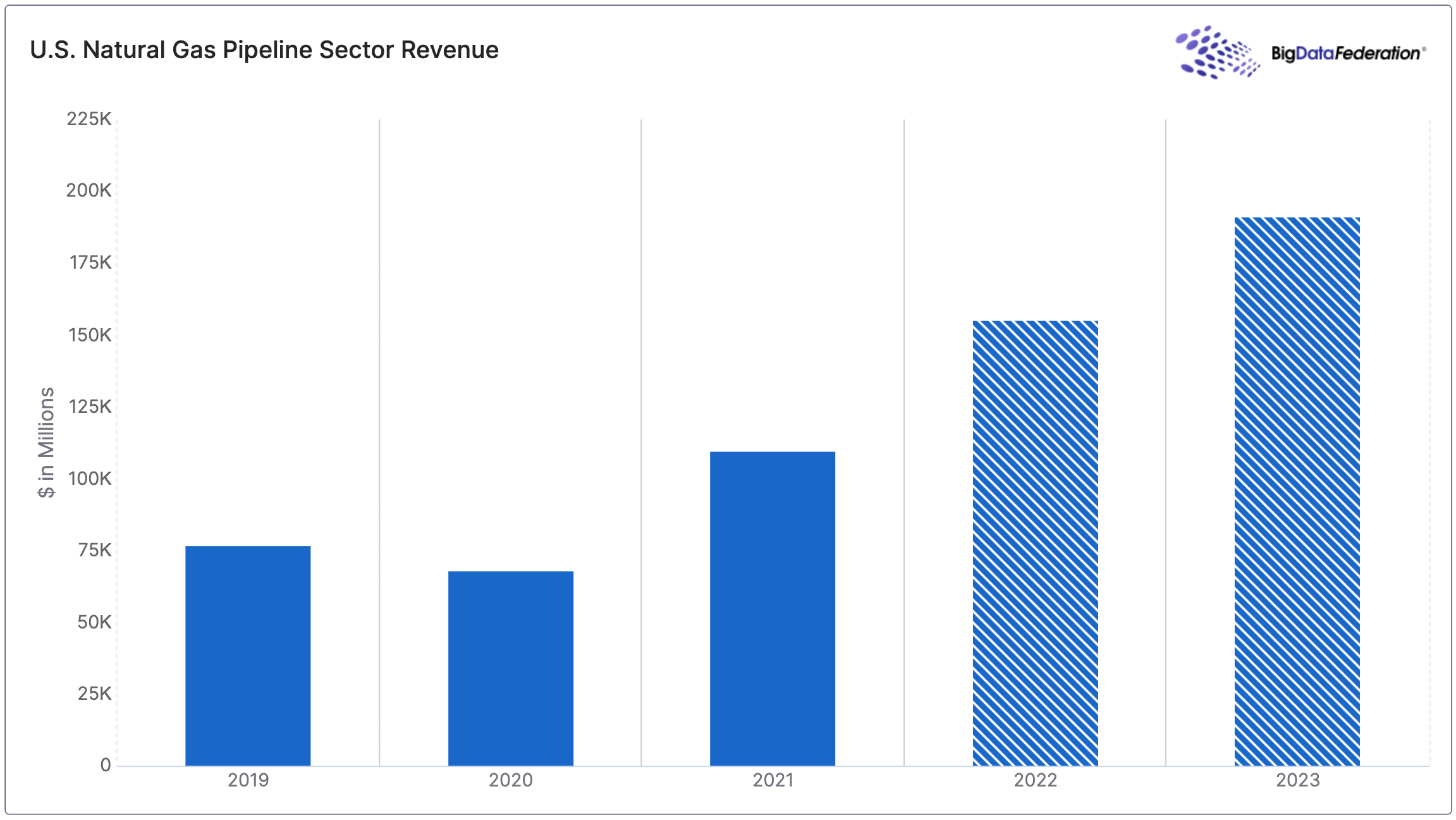
In 2021, natural gas pipeline operators’ revenues grew a hefty 61% year-over-year (YoY). Revenues benefitted from a surge in natural gas prices, combined with a sharp rise in natural gas production and reinstated LNG export capacity. Global natural gas demand recovered from the lows of the pandemic and accelerated due to low-carbon initiatives, particularly in China. Moreover, Russia ended natural gas spot-market sales to Europe mid-year and restricted exports to long-term contracted volumes only. Europe – one of the largest buyers of U.S. natural gas – already dealing with historically low natural gas inventories, struggled to meet winter demand since more than half typically originated from Russia. The sudden active role of the EU on the LNG global market caused regional prices to soar; Henry Hub spot prices, the benchmark for U.S. natural gas, roughly doubled, while European (TTF) and Asian (JKM) benchmarks reached approximately fourfold.
Strong momentum continued into 1H22, as industry revenues gained 45% YoY. Natural gas prices remained near record heights as global demand rebounded while global supply tightened. Russia, the world’s biggest natural gas exporter, had already limited exports to Europe the previous year. However, after Russia invaded Ukraine, Russia’s threats to withhold natural gas supplies from the EU market became more vocal. It prompted the EU to adopt a plan to reduce Russian natural gas imports by two-thirds and search for alternative supplies, and the U.S. helped secure new supplies of LNG to offset shortages. As such, U.S. shale natural gas production, accounting for over three-quarters of output, climbed above pre-pandemic levels. Additionally, LNG export capacity installed the previous year came online, allowing the U.S. to become the world’s largest LNG exporter, surpassing Australia and Qatar.
For 2H22, our algorithms forecast double-digit revenue growth in the high thirties year-over-year. Although slowing sequentially, market conditions remained favorable for pipeline operators. Seasonally higher demand, domestically and internationally, will be partially offset by an unplanned outage at the Freeport LNG export facility. Nonetheless, domestic natural gas production surpassed historical levels and continued upward. Further production increases are plausible as the number of natural gas rigs has climbed aggressively. Notably, Russia’s natural gas exports to the EU decreased meaningfully when Nord Stream 1 shut down indefinitely; the former weaponized export cuts to push forward the certification of a controversial natural gas pipeline. Overall, in 2022, industry revenues will experience robust gains in the low forties.
During 2023, our machines predict industry revenues to grow in the low twenties compared to the prior year. Despite the deacceleration, stable domestic demand, and elevated international demand, coupled with restored export capacity, demonstrate sustained potential. Revenues will be capped by U.S. export capacity, with significant additions not expected until 2024. Liquified capacity must rise to sufficiently service exports, but construction of natural gas transportation infrastructure requires extensive time; it includes building additional pipelines, as well as liquefication facilities.
Published by Big Data Federation · All insights · Subscribe to Insights