First-Quarter Earnings Preview
By Big Data Federation, Inc.

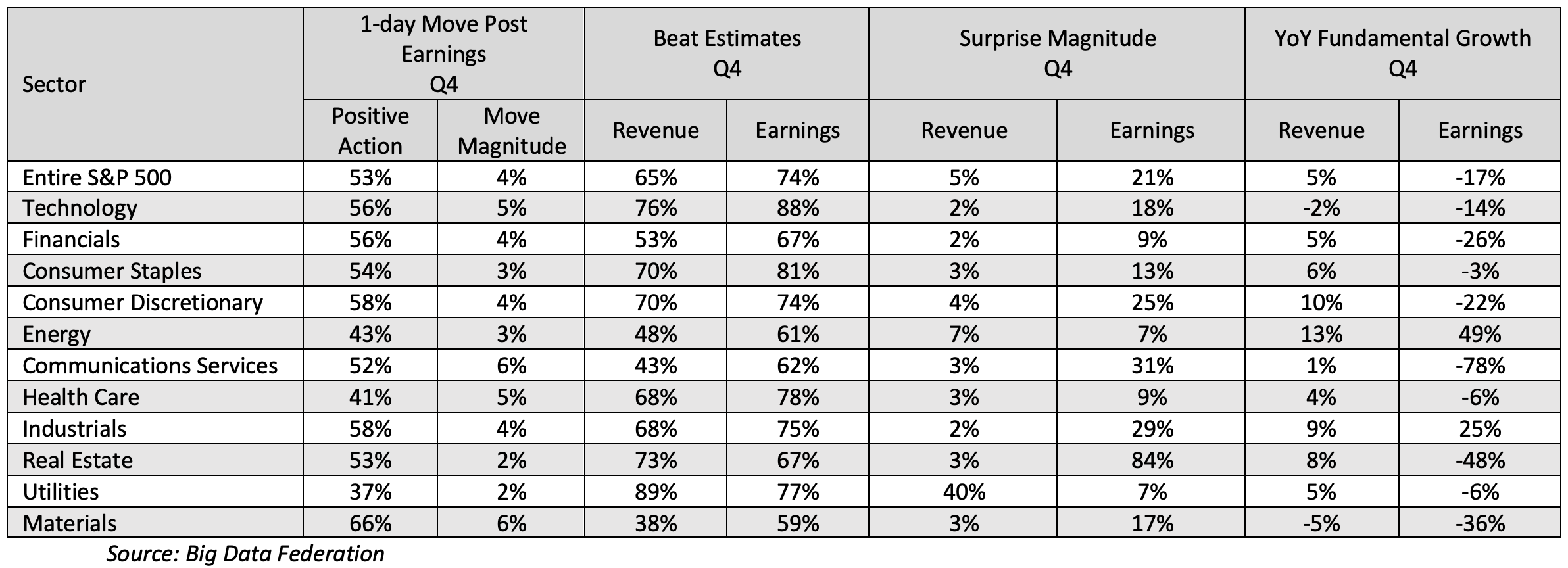
Continued unease in the market and economy caused stocks to move an average of 4% after fourth-quarter earnings releases. Roughly two-thirds beat revenue estimates, while nearly three-quarters beat non-GAAP earnings estimates, as detailed in the table below. Aggregate revenue of S&P 500 companies grew 5% YoY, while aggregate non-GAAP earnings dropped 17% YoY. Positive revenue growth amongst most sectors helped offset the negative change in technology and materials. The transition out of the pandemic economy was still evident, with revenues for energy and consumer discretionary sectors on top, particularly within leisure services like hotels and casinos. Positive earnings growth, however, occurred in only two sectors – energy and industrials, the latter includes airlines. All others were negatively impacted, with communication services, real estate, and materials experiencing the steepest losses. Inflationary pressures cooled one percentage point QoQ but remained higher by half a percentage point YoY and elevated compared to historical standards.
First-Quarter Outlook
Within the first quarter of 2023, economic activity slowed due to a pull-back in consumer spending, down to just +1% QoQ from the average of +5% QoQ last year, and a sustained decline in investment. Core inflation hit a plateau as sticky services, particularly in housing, refused to slow. Additionally, goods, like used and new cars, and other commodities began to tick up. Headline declined substantially, mainly because energy fell 20% YoY. A further slowdown is ahead as the full impact of the bank panic and credit tightening has not unfolded.
Financials sector uncertainty spread last month as bank runs forced the closure of three banks, two at the hands of the FDIC and one voluntarily. Smaller banks, and banks with significant unrealized losses on held-to-maturity securities, were targeted by investors and depositors as the next to fail. Banks moved quickly to increase liquidity by selling securities, borrowing from the Federal Reserve, and tightening loan standards. These steps will hamper earnings, but loan growth ended the quarter positive (1.7% QoQ/ 11% YoY), so earnings should be flat relative to last quarter and up compared to the previous year. Some smaller regional banks will fare worse.
Healthcare sector revenues should register modest growth, driven by a recovery in elective procedures and outpatient volumes. However, margins will remain in the red. While labor expenses held steady because of less dependence on contract labor, it was not enough to offset higher costs across other goods and services due to inflation and upward pricing pressures.
Materials sector earnings should continue to decline as a result of lower commodity prices and slowing manufacturing demand. A stronger U.S. dollar also weighed down profitability. However, commodities prices slightly improved compared to last quarter thanks to the end of the zero COVID policy in China.
Industrials sector revenues will be hit by lower goods traffic and falling transportation rates. Volumes moved by trucks, trains, planes, and ships are casualties of reduced goods demand. A bright spot is the airlines’ subindustry, limited capacity, to minimize cancellations, faced strong travel demand (-4% QoQ/ 24% YoY), which allowed carriers to charge higher ticket prices. Although, earnings will be hurt by higher employee wages across the board.
Technology sector’s revenue and earnings growth will continue to decline due to the macro environment. Sustained falls in semiconductor end-markets, such as consumer electronics and PC sales, will have a measurable impact on memory chips. Deacceleration in capital investments by major telecommunication service providers is also a headwind for wireless semiconductor chips. On the other hand, increased networking demand will benefit wireline communication components. Demand for chipsets with high computing power, particularly GPGPU in data centers, should also extend growth due to expanding AI/ML technologies. Lastly, automotive chipmakers will gain from improved supply chains and climbing auto sales. Semiconductor equipment manufacturers will show a moderate increase in revenue, demonstrating a promising outlook for silicon vendors' future.
Communication Services sector’s financials will slow down. The telecommunications industry is engrossed in fierce competition to bring value to subscribers and steal market share; companies with a larger 5G footprint and better affordability will perform well. Rates of wireless 5G deployments will slow gradually as the major operators have already made heavy capital investments in recent years across the U.S., Europe, and China. Within the advertising subindustry, macroeconomic conditions continue to present a challenging business environment for major digital ad providers. TikTok remains the exception because of its pervasive adoption rate, but its future remains uncertain because of geopolitical issues.
Energy sector revenue will suffer from lower commodities prices for crude oil (WTI: -8.3% QoQ/ -19.5% YoY) and natural gas (Henry Hub: -52.2% QoQ/ -43% YoY), even with a rise in domestic production. Scheduled maintenance activities also pressured revenues amongst refiners. The pricing environment will be a key determinant of future output. Despite lower revenues, earnings will remain profitable because of easing supply chain pressures and declining costs of some oilfield items.
Utilities sector’s performance stabilized as companies overcame unplanned outages from the prior year. Revenues will gain from solid customer growth, especially in the commercial sector, as demand for consumer services rebounded to pre-pandemic levels. Earnings will also improve as fuel costs eased, particularly for natural gas (-42% QoQ/ -32% YoY). However, profitability will be hit by higher depreciation, interest, and benefit expenses.
Real estate sector volatility was at the forefront in the past few months. Mortgage rates see-sawed (-4.4% QoQ/ 68.6% YoY) in response to various news but ultimately ended lower as inflation cooled and bank failures shocked markets. Falling prices could curtail revenues, yet the single-family residential housing market appears to have bottomed out in time for the spring selling season. Earnings should improve as supply-chain pressures are alleviated. Within the equity REITs subindustry, strong travel trends benefit hotel REITs while office REITs struggle to recover.
Consumer Discretionary sector’s revenue growth will be positive. Record commercial gaming revenues and solid hotel performance will bolster the leisure services subindustry. Casinos continue to build on blockbuster revenues, and the winning streak should continue as Macau catches up. Hotels charged higher room rates and collected healthy revenue despite the typical seasonal slowdown in demand. Within the homebuilding subindustry, completions rose as supply chain disruptions resolved, and elevated backlog should help deliver numbers. Confidence improved as mortgage rates appeared to peak and cancelation rates fell. Automobile manufacturers revenue will rise with sales figures as supply chains mend, earnings will also benefit as freight costs lowered, but new car prices remain inflated.
Consumer Staples sector’s revenue is projected to continue to deaccelerate. Cooling inflation contributed to slower revenue growth, and tough competition amongst companies like Walmart and Target created aggressive discounts. Inflation-adjusted spending on food, beverage, as well as health and personal products dropped (-1% QoQ/ -2% YoY). Earnings will gain from stabilized transportation costs, however, those who better manage inventory and associated warehouse expenses will come out on top.
Published by Big Data Federation · All insights · Subscribe to Insights