Fed, Thanks for Nothing (So Far)
By Big Data Federation, Inc.
Roughly a year ago, the Federal Reserve began tightening monetary policy. Federal Reserve Chair Jerome Powell explained, “Basically, across the economy, we’d like to slow demand so that it’s better aligned with supply; give supply, at the same time, time to recover; and get into a better, you know, a better alignment of supply and demand. And that, over time, should bring inflation down.
Our analysis indicates that while inflation has fallen since its peak last summer, that decline has little to do with the Federal Reserve’s aggressive monetary policy tightening so far. Instead, post-pandemic demand dynamics, supply-side improvements, and a helpful oil market did the heavy lifting. That is not to say that monetary policy does not work, but to emphasize its effects on demand appear with a lag; until now, the lag appeared at a distance, but it is getting closer.
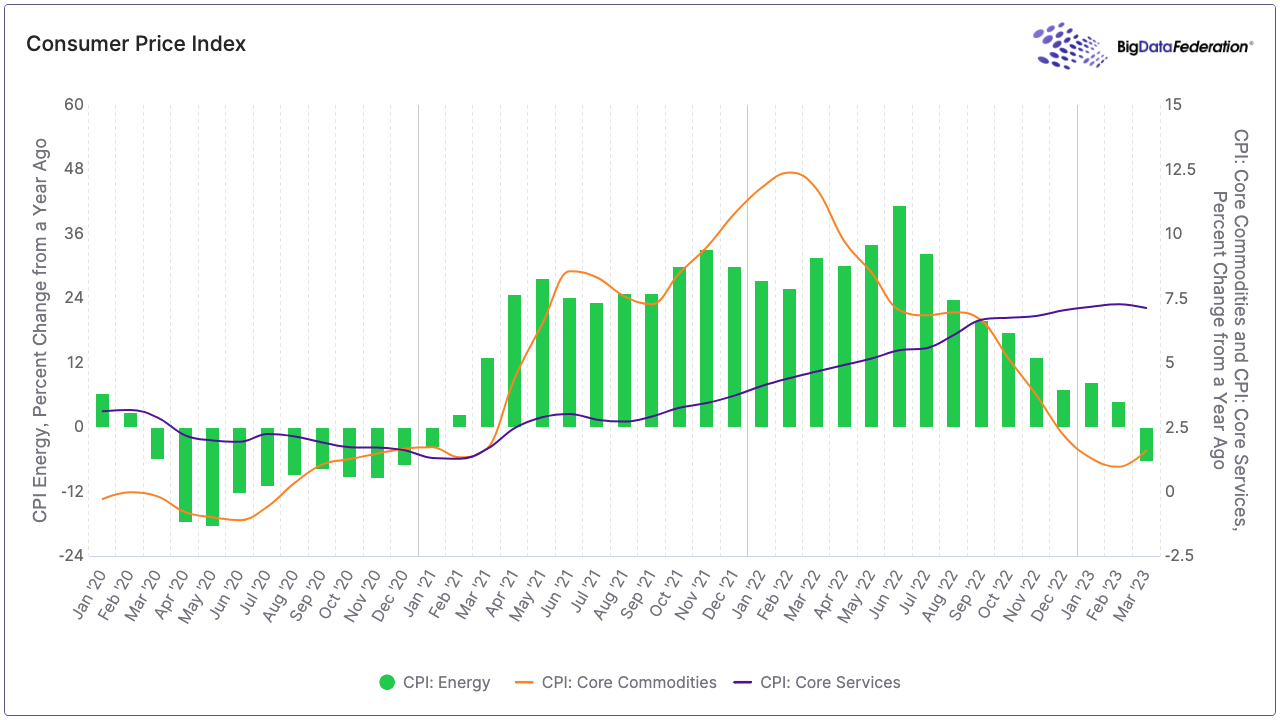
Pandemic-induced inflation essentially happened in three waves. The first involved the increased demand for goods against constrained supply during the pandemic; this began in April 2021 and peaked less than a year later, ahead of the first rate hike. By February 2022, not only had the quantity of goods consumed stabilized, but so had goods prices. Consumption of goods was flat in 1Q22 compared to the previous quarter; the quarterly data is less noisy and better reflects underlying trends. Commodities demand moderated before the Fed acted, and as supply improved, prices fell. Most of the decrease in goods prices can be attributed to used cars prices, but used car demand has not died. Even as we near the terminal rate, used car prices have started to climb again (1% MoM) due to increased demand during the tax refund season. As such, the Fed’s actions have not done much to subdue goods consumption.
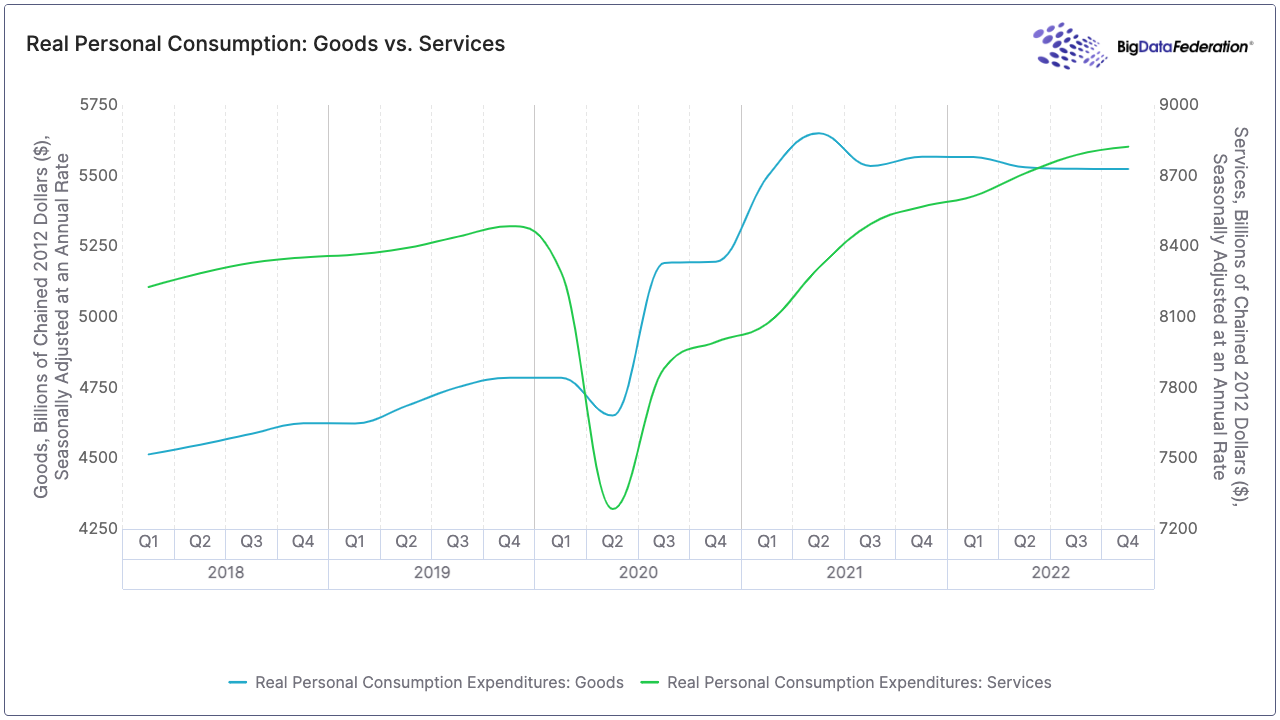
The second wave was the return to services consumption as people resumed post-pandemic life around 3Q21. Services prices climbed as more people rented apartments, traveled, ate out, and indulged in haircuts or other personal grooming services. The number of services consumed exceeded pre-pandemic levels in 4Q21 and continues to grow. This wave of inflation has yet to peak and is the primary cause of concern for the Fed. Once again, the Fed has yet to dent services demand and inflation.
These two waves of inflation were very different from the 1970s, triggered by a massive shutdown and reopening of the world economy. It meant most issues would self-correct as people and the economy resumed pre-pandemic activities.
The last wave of inflation, a consequence of the Russia-Ukraine conflict, skyrocketed prices of food, energy, and other commodities. As it became apparent that these commodities would still make it to the world market, respective prices abated. In addition, global recession fears and a drop in gasoline demand as it became expensive weighed down energy prices. It helped bring down the Consumer Price Index (CPI) because energy is a significant component, and the market price almost directly enters the price index.
 Although the Fed’s actions have so far done little to impact real consumption*, they have had an outsized effect on the financial markets. As the era of cheap money ended, speculative bubbles in the crypto, stock, and real estate market popped. Rising rates caused bond values to collapse and triggered the bank liquidity crisis in March (Regional Banks). While the turmoil was restricted to a handful of banks, banks have begun to limit credit. Total loans decreased since mid-March and appeared to be reaching a turning point from growth to decline. For the first time since mid-2021, weekly data fell compared to the equivalent week a month ago (-1% MoM). The Senior Loan Office Survey also shows tightening lending standards; the net percentage of banks reporting tightening for Commercial & Industrial loans increased forty-five percentage points YoY and six percentage points QoQ in 1Q23.
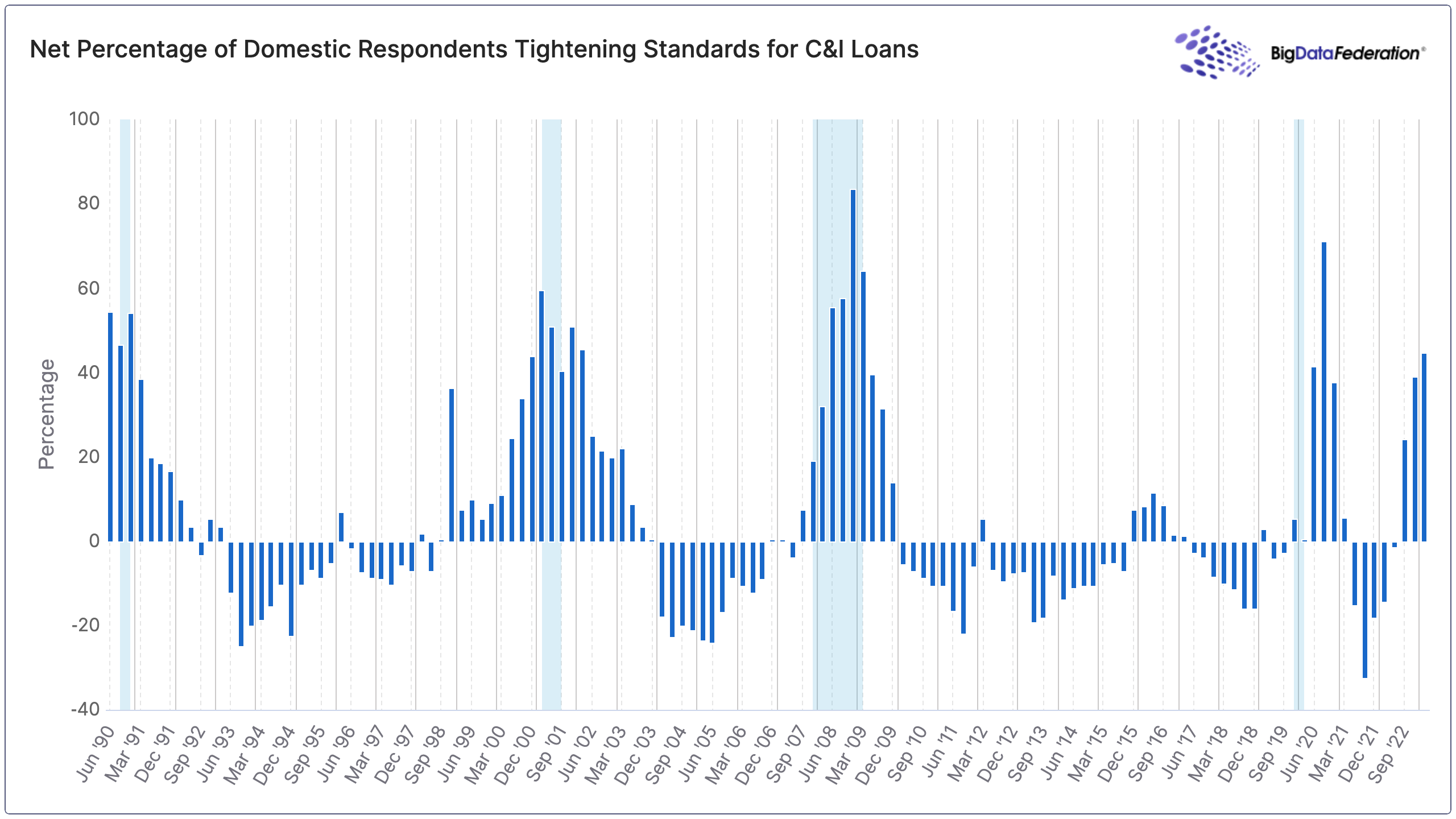
Many large banks mentioned some form of lending pull-back in the 1Q23 earnings calls. Jamie Dimon said, “I wouldn’t use the word credit crunch if I were you. Obviously, there’s going to be a little bit of tightening.” Lastly, the April 2023 Federal Reserve Beige Book reports anecdotal evidence that bank lending has pulled back. When banks limit credit, it becomes harder for business and consumers to borrow and spend, and real consumption declines. Once real consumption declines, inflation will follow, and this time, it will be due to the Fed actions. At that point, the Fed can finally claim responsibility for the disinflation. Even so, the potentially delayed slowdown in consumption may place the Fed in an awkward situation, where a recession hits when inflation is already within an acceptable range, and they will have to rush to cut rates.
*inflation-adjusted
Published by Big Data Federation · All insights · Subscribe to Insights