AI-Optimized Asset Allocation for Fed Fund Rates Scenarios
By Big Data Federation, Inc.

Federal Open Market Committee (FOMC) will wrap up its fifth meeting of the year. Forward guidance has been closely followed. Federal funds rate is one key factor in asset allocation; however, how to optimally allocate assets based on various unfolding scenarios for a spectrum of investors’ goals has been an age-old complex problem.
Leveraging our big data and machine learning models, we hypothesize a range of scenarios ahead of the Federal Open Market Committee’s meeting. Our sample range includes the expectations set by futures markets, according to the CME FedWatch tool as well as other economic consensus. As displayed in the table below, our multi-asset portfolio includes bonds, S&P 500, and commodities. Each scenario produces three bespoke portfolios, optimized for either the Sharpe Ratio, return, or risk.
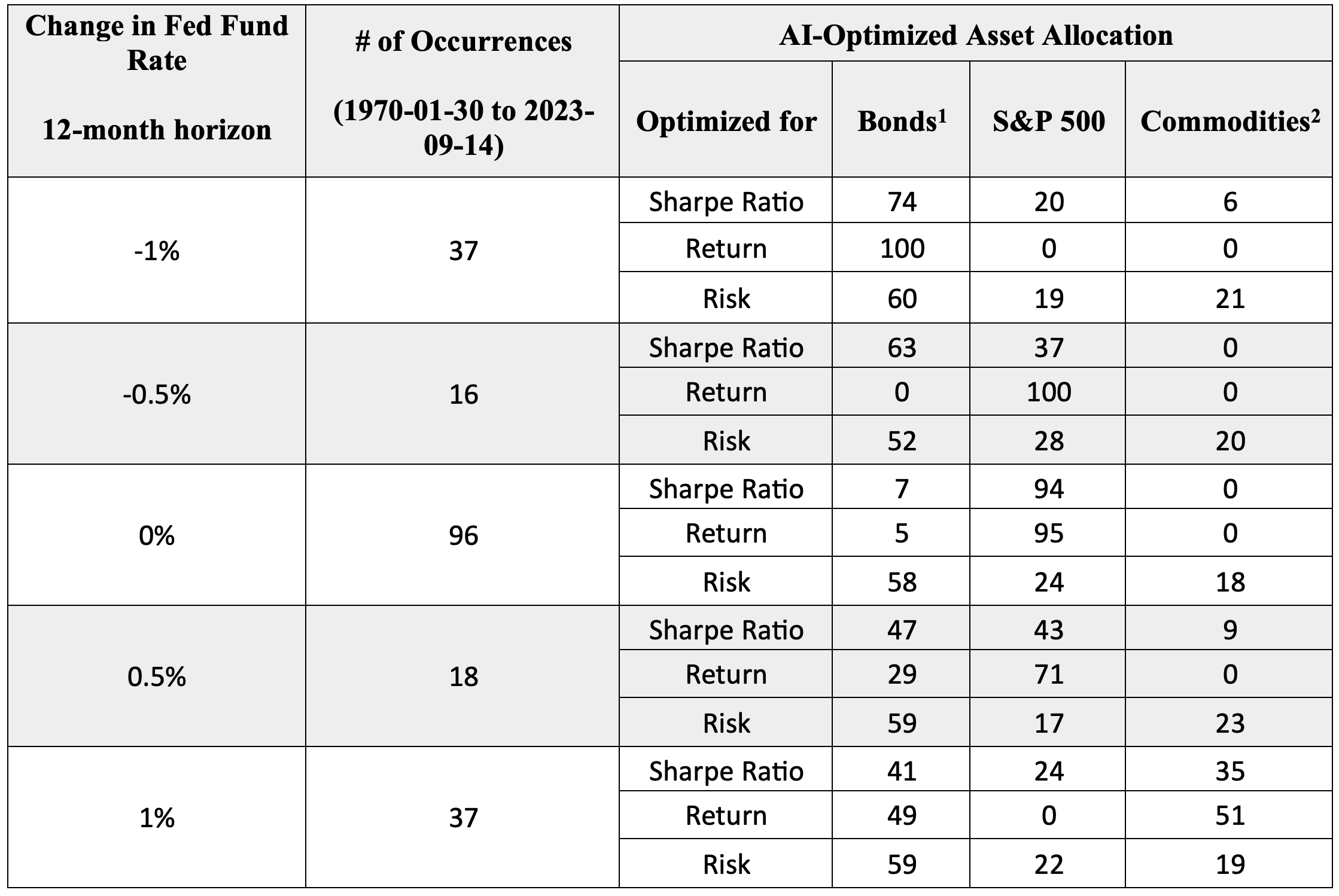
Initially, our models complete an extensive search throughout history, dating as far back as the 1920s if the data is available, to identify periods that match the defined scenario. Next, our machines capture monthly returns for all portfolio components over the identified period that match the defined scenario. Finally, our algorithms solve a nonlinear optimization problem, considering the performance of individual components and their correlations while adhering to given constraints.
About OdinUltra
OdinUltra is a cutting-edge no-code specialized AI platform, designed to cater to a wide array of professionals in the asset management industry. It is a battle-tested specialized partner that empowers users including discretionary, quantitative, multi-asset, and multi-strategy managers to harness the immense potential of big data and sophisticated investment techniques. From idea exploration and construction to verification and deployment, OdinUltra is an all-encompassing tool. Asset managers can enhance existing products and rapidly develop new ones, securing a competitive edge in the dynamic world of asset management.
Published by Big Data Federation · All insights · Subscribe to Insights