Aftershocks Reverberate Through Housing Market
By Big Data Federation, Inc.

-
Asking rents decreased for the second consecutive month yet shelter remained a significant contributor to inflation
-
Spread between the 30-Year Fixed-Rate Mortgage and 10-Year Treasury Yield surpassed its historical trend
-
As prospective buyers face steep prices and rising rates, mortgage applications for purchases dropped
Residential real estate continues to experience shifts, for both tenants and buyers. Asking rents decreased for the second consecutive month (-1% MoM), finally displaying signs of leveling off. Nonetheless, it remained elevated compared to other periods (6% YoY/ 22% YoY3). As such, this relief was not evident within inflation figures measured by the year-over-year changes in the Consumer Price Index (CPI). Shelter remained a significant contributor to headline and core inflation, with the component rising 1% MoM and 7% YoY. Its portion continued to accelerate while overall inflation lowered. Although asking rents, i.e., prices for newly signed rental agreements, fell, CPI incorporates existing and new leases. Hence, there will be a lag until the effects of cooling rents show up in inflation numbers.
|
Data (October) |
MoM |
YoY |
YoY31 |
|
Asking Rents |
-1% |
6% |
22% |
|
Consumer Price Index: Shelter |
1% |
7% |
N/A |
|
30-Year Fixed-Rate Mortgage (FRM) |
13% |
125% |
87% |
|
Spread: 30-Year FRM and 10-Year Treasury Yield |
12% |
96% |
47% |
|
Purchase: Mortgage Loan Amounts |
-2% |
-2% |
21% |
|
Purchase: Mortgage Loan Applications |
-15% |
-40% |
-34% |
Source: Big Data Federation, Inc.
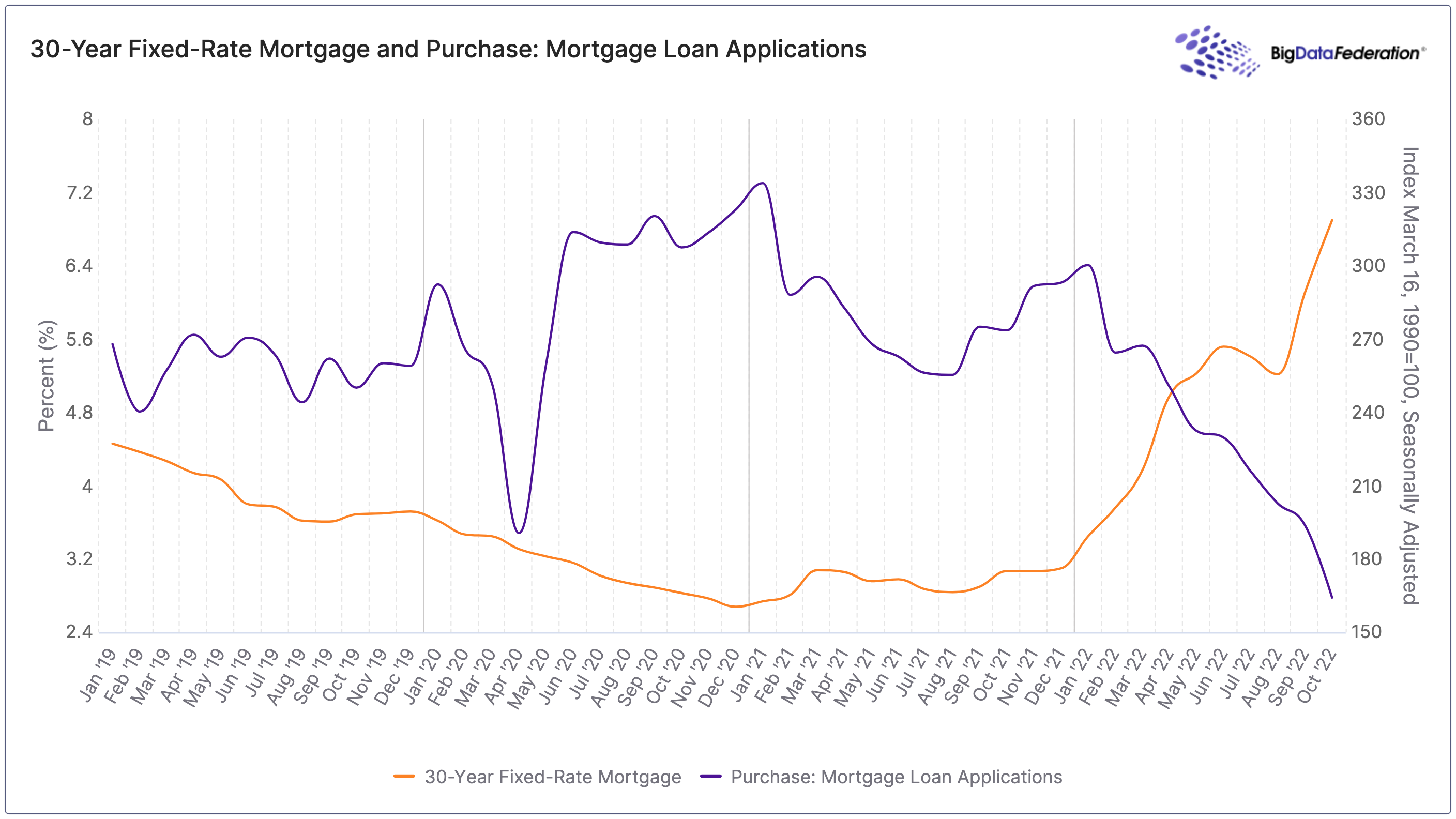
With the Federal Reserve's ongoing actions to quell inflation in the broader economy, mortgage rates are slated to escalate further. Typically, the 30-Year Fixed-Rate Mortgage (FRM) and the 10-Year Treasury Yield move in lockstep; the difference is called the spread. However, recent factors specific to the mortgage-backed securities (MBS) market widened the gap more than usual. Part of the Fed's quantitative tightening included reduced MBS purchases by the central bank, and others followed. Fewer participants meant less liquidity in the secondary mortgage market, and investors demanded greater returns to hold or buy MBS, pushing mortgage rates higher. The 30-Year FRM – the most popular home loan product – reached seven percent (13% MoM/ 125% YoY/ 87% YoY3). Consequently, the spread surpassed its historical trend (12% MoM/ 96% YoY/ 47% YoY3).
Mortgage loan amounts for purchases have declined (-2% MoM/ -2% YoY), reflecting the turnaround in home prices but remain above pre-pandemic norms (21% YoY3). Prospective buyers still face steep prices, and combined with rising mortgage rates, it is unsurprising that mortgage loan applications for purchases dropped (-15% MoM/ -40% YoY/ -34% YoY3). Applications hit levels below the lows at the start of the pandemic and hovered near levels amidst the Great Recession. Given the pace of the Fed, the cumulative effects have not yet trickled down, and more time is needed to assess the final impacts.
1YoY3 = comparison with October 2019
Published by Big Data Federation · All insights · Subscribe to Insights