Where Utilities Outperform
By Big Data Federation, Inc.

The Utility sector has long been treated as a classic defensive allocation—steady cash flows, regulated returns, and reliable income. ETFs like the widely followed Utilities Select Sector SPDR Fund (XLU) are often used as ballast when volatility rises. But what if “defensive” doesn’t have to mean “passive”?
Using Financial AI, we tested a simple idea: instead of owning the full benchmark, what happens if you apply a filter within the sector itself?
Specifically, we constructed an equal-weighted portfolio of utility companies headquartered in Republican-leaning states. This reduced the universe from 32 names in XLU to just 17—and the results were striking. The portfolio outperformed the benchmark meaningfully on an annualized basis, delivered a higher Sharpe ratio, and experienced lower drawdowns.
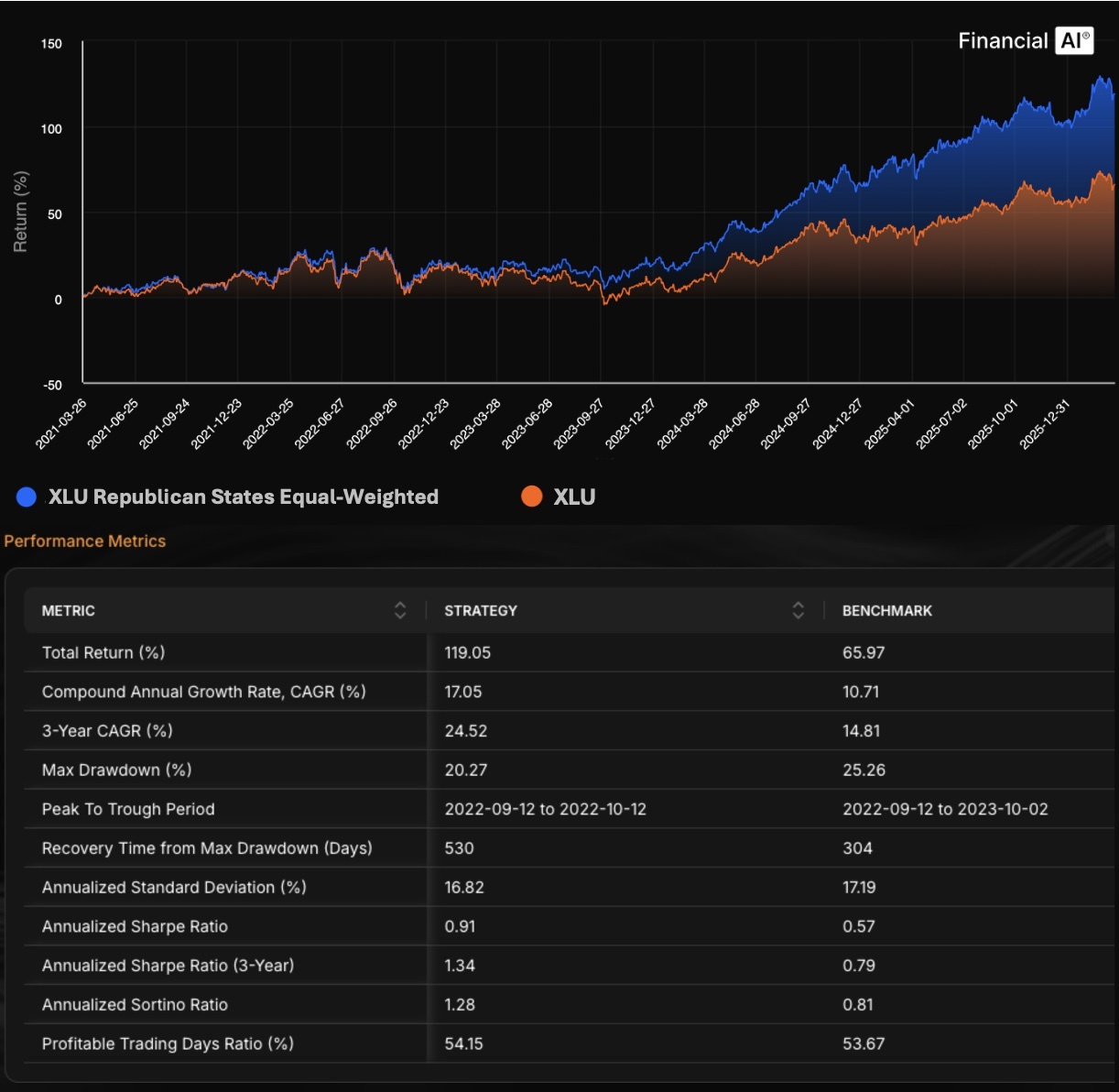
At first glance, it’s tempting to frame this as a political signal. It’s not. The real drivers are structural.
Utility performance is heavily shaped by regulation. Returns are not purely market-driven—they’re negotiated, approved, and constrained by state-level frameworks. This introduces meaningful dispersion beneath the surface of what many investors treat as a “uniform” sector.
Three factors stand out:
-
Regulatory frameworks: Some states allow more favorable rate-setting mechanisms, enabling utilities to earn higher returns on capital.
-
Policy priorities: Differences in emphasis—consumer cost protection vs. infrastructure investment—can materially impact profitability.
-
Cost structures & regional growth dynamics: Local economics, demand patterns, and demographic shifts shape both the resilience of cash flows and the runway for future growth
Political alignment tends to correlate with these dynamics, which is why the pattern emerges—but it’s a proxy, not a cause. In an environment where investors are increasingly looking to reduce macro sensitivity without sacrificing returns, this kind of targeted selection offers a compelling middle ground—defensive exposure, with a layer of structural alpha.
Published by Big Data Federation · All insights · Subscribe to Insights