Manufactured Home Sales Slide
By Big Data Federation, Inc.

-
Manufactured home shipments slump amidst interest rate surge
-
Financed via chattel loans, buyers face higher interest rates than traditional mortgages
-
Lumber prices, a significant component in framing costs, can further impact affordability
Manufactured homes, also known as prefabricated homes, are typically considered an affordable alternative to site-built homes. On average, manufactured homes are priced four times lower than traditional site-built homes. Initially introduced to address the housing shortage, it also offered mobility, flexibility, and customization. Favored by various demographics, manufactured housing generally accounted for approximately one-tenth of building permits on a national scale.
More recently, manufactured home shipments have declined to levels not witnessed since 2016 (0% MoM / -32% YoY / -12% YoY4). Year-over-year comparisons are significantly brutal because manufactured home sales had reached an unprecedented extent during the intense demand of the red-hot housing market spurred on by historically low interest rates. Chattel loans are the most common form of financing for manufactured housing, distinguished from traditional mortgages by the collateral used to secure the loan. A chattel mortgage relies solely on the structure as collateral, while a conventional mortgage encompasses both the land and the structure.
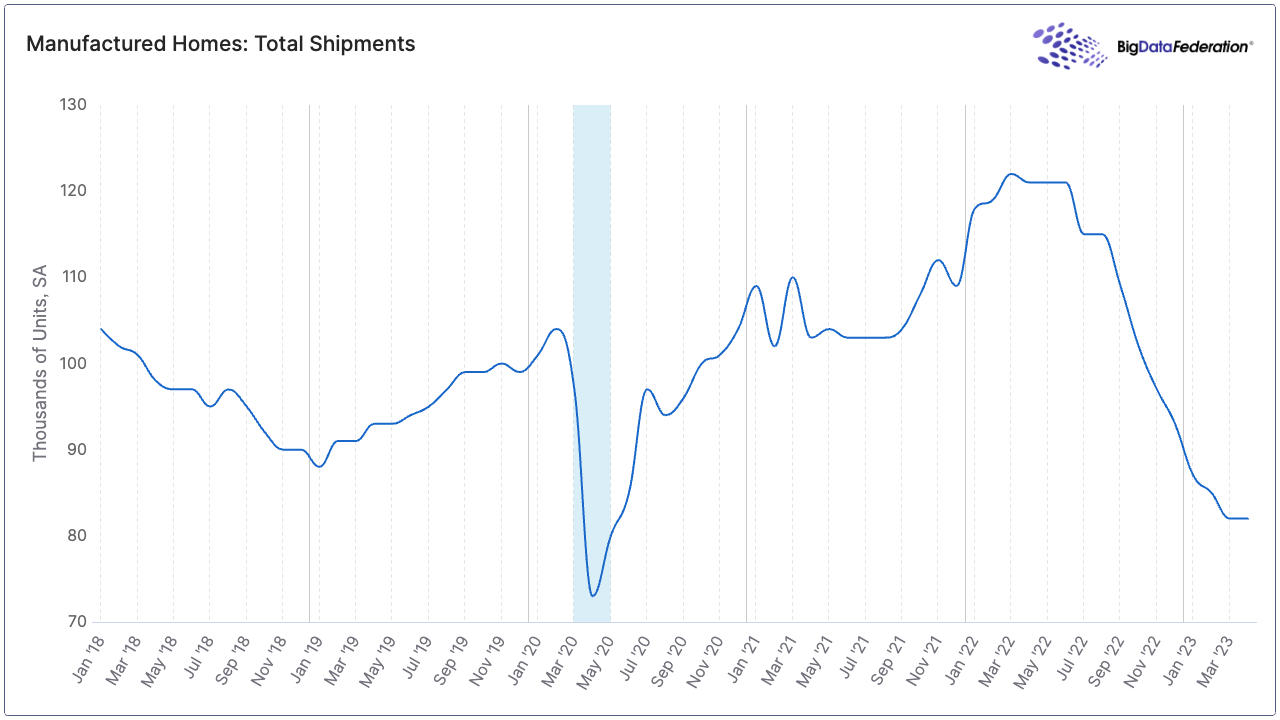
As such, chattel loans carry more risk, with lenders charging higher interest rates compared to traditional mortgage loans. Chattel loans for manufactured housing normally have shorter terms of fifteen to twenty years, unlike the thirty-year terms common for regular mortgages. Given the current upward trajectory of the federal funds rate, and thus mortgage rates of all terms, including the fifteen-year fixed rate mortgage (-2% MoM/ 34% YoY/ 57% YoY4), several prospective manufactured home buyers opted to remain on the sidelines. Usually, a chattel loan interest rate is one to two percent higher than a conventional mortgage loan.
|
Data (April) |
MoM |
YoY |
YoY4 |
|
Manufactured Homes: Total Shipments |
0% |
-32% |
-12% |
|
15-Year Fixed Rate Mortgage |
-2% |
34% |
57% |
|
Average Lumber Futures Contract Price |
0% |
-60% |
12% |
|
Producer Price Index: Manufactured Homes |
0% |
-3% |
49% |
Source: Big Data Federation, Inc.
Lumber prices, a significant component in framing costs, will further impact average sales prices of manufactured homes and thus affordability (0% MoM/ -60% YoY/ 12% YoY4). Changes have heavily reflected in the producer price index for manufactured homes (0% MoM/ -3% YoY/ 49% YoY4). Although manufactured homes are more likely to be an inexpensive option in the new housing market than site-built homes, the persistence of elevated financing rates will further persuade purchasers to shift attention to the latter.
1YoY4 = comparison with pre-pandemic 2019
Published by Big Data Federation · All insights · Subscribe to Insights