Inflation’s Trajectory Can Alter Fed’s Path
By Big Data Federation, Inc.

-
Core goods, housing services, and core services ex-housing need to decline before the Federal Reserve pauses rate hikes
-
All three are declining or are anticipated to decline in the coming months
-
If this trend continues, Powell will need an alternate excuse to raise rates in the spring
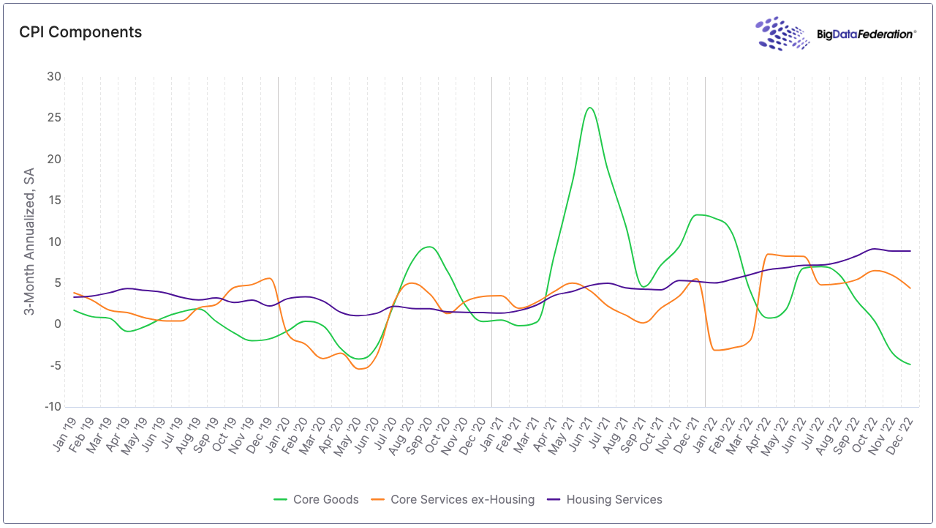
Towards the end of last year, Jerome Powell highlighted three components of inflation that the Federal Reserve is tracking to understand inflationary trends: core goods, housing services, and core services ex-housing. Powell argued that all three needed to exhibit a consistent downward movement for the Fed to accept that inflation is indeed slowing and for the Fed to consider pausing additional rate increases. The latest inflation readings show a clear trajectory toward fulfilling these conditions, making it likely that the FOMC will dial back rate hikes to 0.25 at the next meeting. And if the January and February reports continue on this trajectory, Powell will need to find an alternative argument to justify rate hikes at the March FOMC meeting.
Core goods strips out the most volatile components, i.e., food and energy, and includes apparel, household furnishings, electronics, and other commodities like used cars. It was forecasted to decline first as used car prices have receded from a peak last summer. Core goods inflation is now decreasing month-over-month (MoM), driven mainly by used cars. In December, the three-month annualized inflation figure was -4.8%. As used car prices are likely to fall thru 2023, so will core goods.
Housing services started to receive attention when it heavily contributed to core services inflation. It includes two main components, rent of primary residence and Owner’s Equivalent of Rent (OER). Rent of primary residence is constructed using new and continuing leases, and OER utilizes the same data, so the two track each other, and in fact, have a correlation of 0.93. Price movements in new leases enter rent of primary residence, and thus OER, with a lag of anywhere from 6-9 months; therefore, both are anticipated to cool as early as spring as the rent for new leases has been falling since late last summer.
Finally, core services ex-housing is the remaining cause for concern for the Federal Reserve. Core services ex-housing is tied closely with the tight labor market and subsequent higher wages. Since services are labor intensive, the Fed believes rising wages will continue to push up the price of these services and further fuel inflation. The lack of progress in containing inflation in this category, as well as rising wages, were cited as a reason monetary policy needed to tighten more. Since Powell’s comments, core services ex-housing stabilized, and its three-month annualized growth declined to 4.4% in December from 6% in November. In addition, average hourly wages for the service industry fell to 4.9% YoY in December from 5.4% YoY in November. If this stabilization continues in the next few months, then Powell will need to provide a backup excuse to raise rates in the spring.
Published by Big Data Federation · All insights · Subscribe to Insights