Inflation Heating Up But Stay Calm
By Big Data Federation, Inc.
As the pandemic hit every corner of the world, consumers went from survival to boredom to revenge spending. Supply chains were indiscriminately impacted in extraordinary ways as consumers’ demand shifted drastically and businesses became unable to forecast demand. And it all started with toilet paper.
Our algorithms predict inflation rates (headline and core) will peak in the summer and decline in the second half of 2021, as the demand-supply gap closes. While inflation numbers will look scary for the next few months, our machines project that annual core inflation will end the year at 2-3%, well within the norm. Core inflation represents the underlying trend as it excludes volatile components (food and energy prices) that are captured in headline inflation.
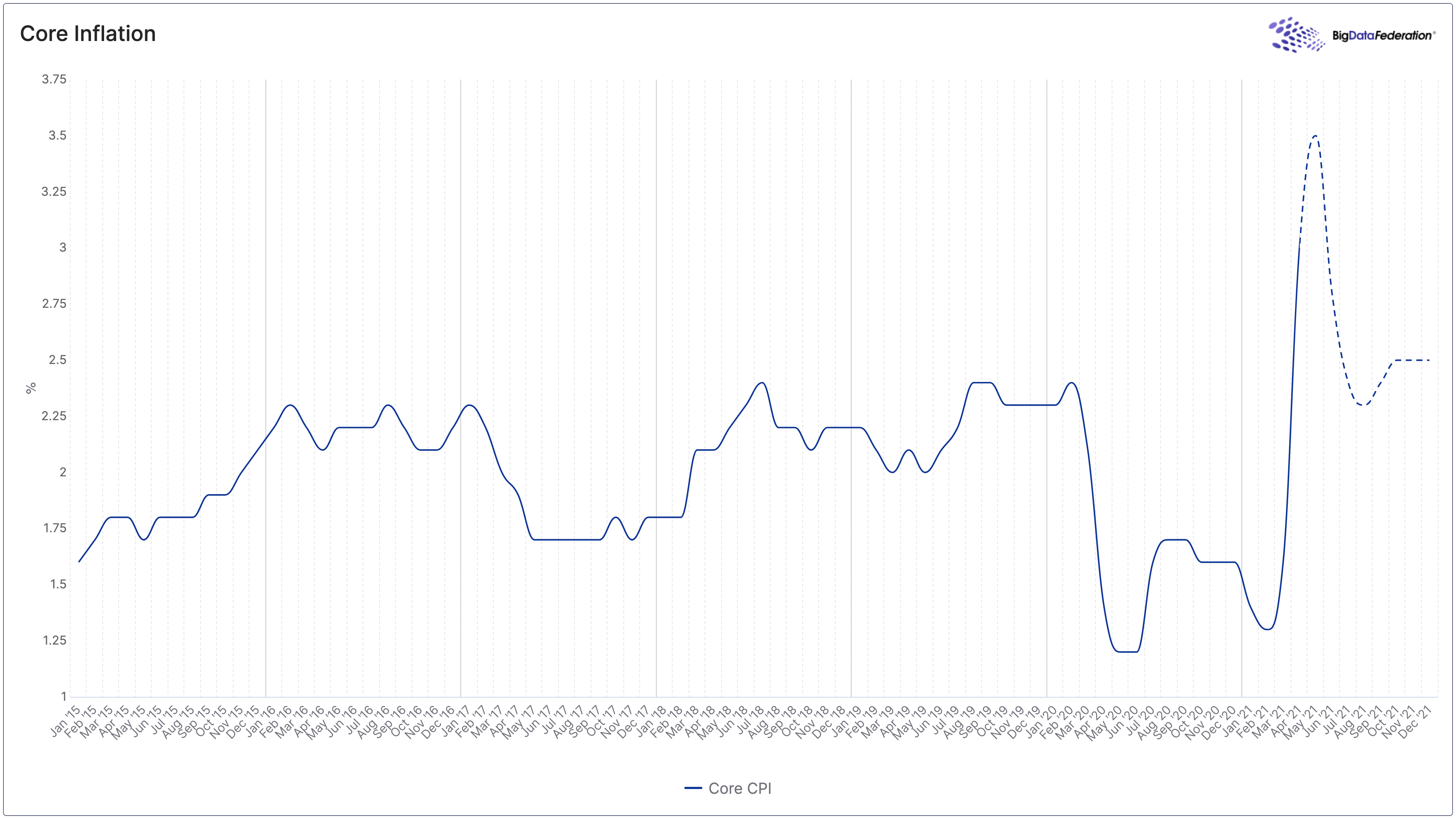
The recent acceleration in inflation numbers was mainly caused by price increases in lodging rates, airfares, used cars, input costs, in addition to the labor shortage.
- As of April 2021, hotel room supply is already back to pre-pandemic volumes and our algorithms predict that the average daily rate will stabilize by August 2021, as pent-up demand is released.
- Airlines available seat miles (ASM) was down 35% last quarter compared to the previous year, however, our machines forecast passenger carrying capacity to return to regular levels by end of 3Q21.
- In May 2021, used car prices are up nearly 25% year-over-year because of low new car inventory. Production slowed down due to the semiconductor shortage and our algorithms calculate this effect to mostly diminish by the end of the year.
- Increases in input costs arose from supply chain disruptions of commodities. While it is hard to estimate input costs, our data indicates that the impact is moderating and should normalize by the end of 2021.
- The labor shortage is not from a lack of job opportunities, as evidenced by job openings which stand at all-time highs in U.S. recorded history. Labor shortages should resolve as childcare options reopen, schools restart, stimulus checks run out and enhanced unemployment benefits end by September 2021. Our machines project labor costs to remain elevated, slightly above the nominal core inflation rate.
Currently, the US personal savings rate is 27.6% compared to the historical savings rate of around 7%. This jump is related to the lack of spending opportunities during lockdowns, stimulus checks, and eviction moratoriums. Using high-frequency data, our algorithms predict US consumers will deplete excess savings within 3-6 months, reaching a 10% savings rate towards the end of 2021.
In conclusion, the rise in core inflation will most likely subside starting from July 2021, ending the year around the Federal Reserve’s 2-3% target. Our algorithms agree with the Fed on the transitory nature of this pandemic-induced inflation.
Published by Big Data Federation · All insights · Subscribe to Insights