Health Insurers Maintain Winning Streak in Post-Crisis Era
By Big Data Federation, Inc.

-
COVID-19 crisis had limited impact on health insurance revenues, and low medical utilization led to a boom in profits.
-
Strong membership trends will drive up 2022 health insurance revenues.
-
In 2023, the growth will be fueled by higher premium prices and a larger labor force.
Health insurers proved resilient during the pandemic. Health coverage loss during the COVID-19 crisis had limited impact on industry revenues, and in fact, led to a boom in profits due to low medical utilization.
For 2022, we predict double-digit revenue growth in the low teens, driven by strong membership trends predicated on continued employment growth. As for 2023, our algorithms forecast high-single-digit growth fueled by increases in both premium prices and the labor force.
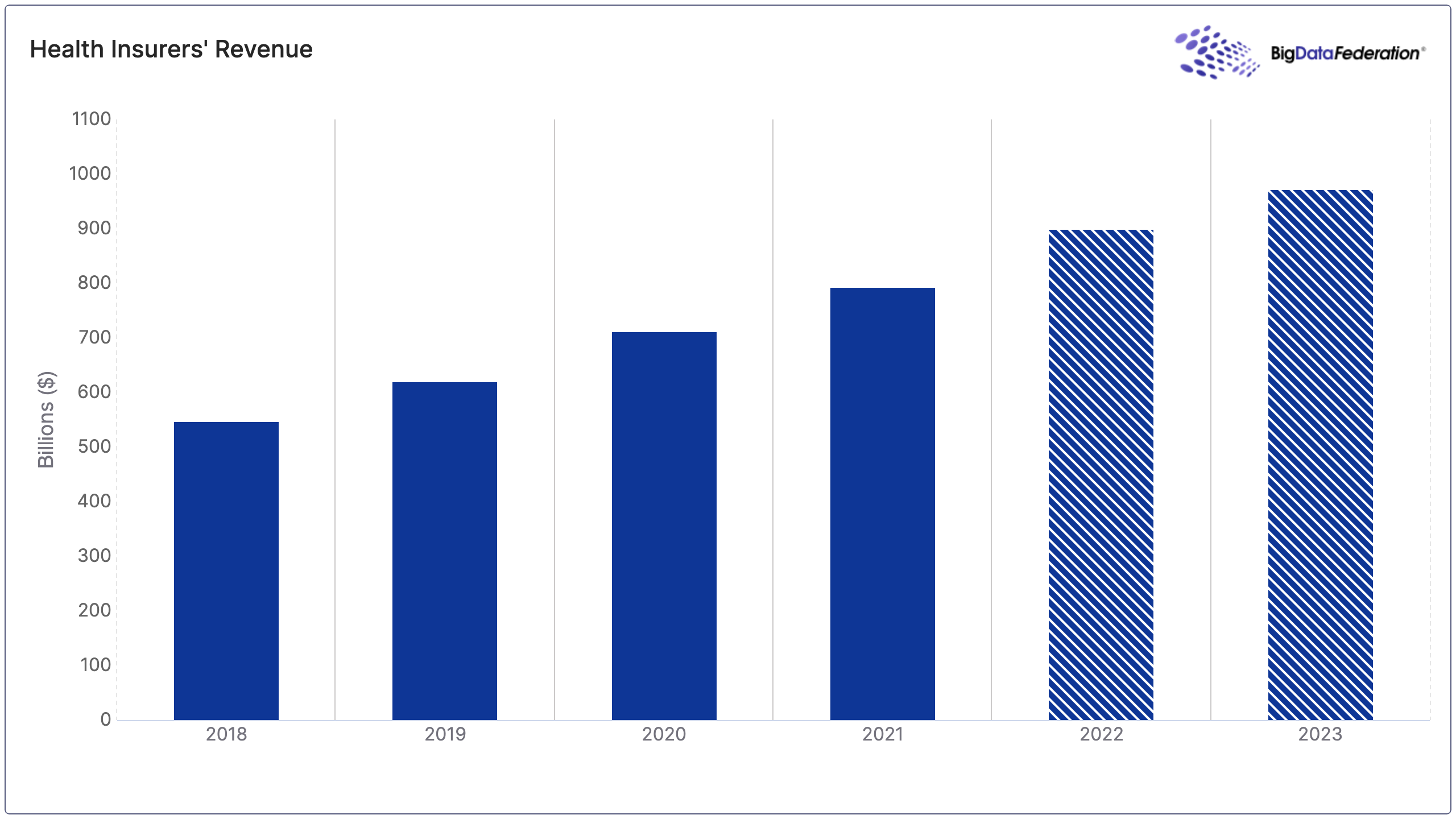
During 2020, despite a record level of unemployment, industry revenues grew +15% YoY, facilitated by relief legislation and other policies enacted during the pandemic*. The aforementioned benefits helped mitigate industry losses as those who lost access to employer-sponsored insurance qualified for a public (Medicare/Medicaid) or subsidized private insurance (the Marketplace). It translated into higher Medicaid enrollment (+6% YoY) and Marketplace new enrollees levels (+5% YoY). Enrollment in Medicare Advantage plans, private plans offered to Medicare beneficiaries, also improved (+4% YoY). The policy changes brought down the number of uninsured (-2% YoY) and fostered national spending on health insurance (+29% YoY).
In 2021, industry revenues grew +12% YoY, driven by resilient membership trends – boosted by job market recovery, enhanced benefits included in the American Rescue Plan Act (ARPA)3, and the Special Enrollment Period4. With pandemic restrictions waning and the economy gradually reopening, employment levels picked up (+3% YoY) and more people participated in employer-sponsored health plans. Enhanced benefits and longer enrollment periods led 12.2 million Americans to enroll in coverage under the Affordable Care Act (+5% YoY). Moreover, enrollment in Medicare Advantage plans climbed (+3% YoY) as more individuals aged into Medicare and purchased the additional private coverage. The COVID-19 related shift to public insurance began to reverse.
In 1H22, industry revenues grew +7% YoY while national health insurance consumption rose +3% YoY; supported by the record-breaking 14.5 million people (+19% YoY)5 who signed up for health insurance plans during the Marketplace Open Enrollment for 2022. Enrollment levels in Medicare Advantage plans increased +9% YoY; this trend will continue as more baby boomers become eligible for Medicare and opt for the more benefit rich Advantage plans. Additionally, the sequential growth in Medicaid, driven by the ongoing suspension of eligibility redeterminations, led the industry revenues growth.
For 2H22, our machines predict double-digit YoY growth in the low teens. With pandemic impacts fading, labor-force participation will improve as many feel safer to return to work, driving participation in employer-sponsored health insurance. Meanwhile, Medicaid membership is anticipated to fall at the end of the year as states resume eligibility redeterminations6. We expect this’ll be partially offset by membership additions in employer-based plans and redistribution to Marketplace plans. Declines in Medicaid membership will mostly impact 2023 industry revenues as the redeterminations will commence over fourteen months7.
For 2023, our algorithms forecast high-single-digit growth driven by stable membership trends and increasing premium rates to counteract higher costs and utilization. According to submitted 2023 rate fillings from plans participating in the Marketplace, insurers are proposing to raise premiums by more than usual – the median suggestion is a 10% increase. While one of the provisions in ARPA makes private coverage through the Marketplace more affordable, ARPA is set to expire at the end of 2022. Termination of the act will modestly negatively impact enrollment in health insurance plans in 2023, but this will be offset by enrollment growth in employer-based plans.
*Under the Families First Coronavirus Response Act1 — effective March 2020 — states have been required to maintain continuous coverage for Medicaid enrollees in order to receive a 6.2 percentage point increase in the share of Medicaid costs the federal government covers known as the Federal Medical Assistance Percentage (FMAP)2. Additionally, the act established that enrollees aren’t subject to coverage redeterminations, which often result in lost coverage due to income fluctuations.
1Families First Coronavirus Response Act (FFCRA) – FFCRA was enacted on March 18, 2020. It is the second of three comprehensive laws enacted in March specifically to support the response to the pandemic. FFCRA provides for an increase to all states, the District of Columbia, and territories in the share of Medicaid expenditures financed by the federal government, subject to specific requirements. It provides additional Medicaid funding to territories. FFCRA modifies requirements related to waiving certain Medicare telehealth restrictions during the emergency. Finally, FFCRA waives liability, with a narrow exception, for manufacturers, distributors, or providers of specified respiratory protective devices used for COVID-19 response.
2Federal Medical Assistance Percentage (FMAP) - The Federal Medical Assistance Percentages (FMAPs) are used in determining the amount of Federal matching funds for State expenditures for assistance payments for certain social services, State medical and medical insurance expenditures. The “Federal Medical Assistance Percentages” are for Medicaid.
3American Rescue Plan Act (ARPA) - the American Rescue Plan Act was implemented in the Marketplaces, and more generous advance payments of premium tax credits (APTC) have become available to most consumers, this reduced premiums and enhanced enrollments.
4Special Enrollment Period - In response to the COVID-19 Public Health Emergency, all state health insurance Marketplaces opened a Special Enrollment Period, that allowed consumers to enroll outside of the annual Open Enrollment Period. The Special Enrollment Period rolled out from spring to summer 2021, and the total of over 2.8 million Americans signed up for health coverage.
5 Thanks to increased funding for outreach to the uninsured, enhanced subsidies from the American Rescue Plan, and the launch of the Marketplace Open Enrollment Period for 2022.
6 The continuous Medicaid enrollment provisions are tied to the public health emergency (PHE) period, which is currently set to expire in October 2022. The Biden Administration has said that it will give states a 60-day notice before the PHE expires.
7Given guidance from the Centers for Medicare & Medicaid Services (CMS) that ask states to have up to 14 months to redetermine members, and not redetermine more than one-ninth of that membership in a single month
Published by Big Data Federation · All insights · Subscribe to Insights