Forecasting Deceleration in Enterprise Spending Growth
By Big Data Federation, Inc.

Monetary policy is a key driver in shaping enterprise capital expenditures (CapEx). Our analysis highlights the intricate relationship between interest rates and CapEx. Based on our machine learning models, we anticipate a modest yet stable slowdown in enterprise spending for the full year 2025.
In a first-of-its-kind, in-depth study, we leverage advanced financial AI technology to quantitatively forecast the aggregated S&P 500 CapEx, incorporating anticipated rate moves and other economic factors. By aggregating point-in-time information, our analysis offers a dynamic and real-time perspective on evolving trends.
In the chart below, we show the 10-year yield alongside the year-over-year (YoY) growth of S&P 500 CapEx. While Fed funds rate changes tend to cause sharper fluctuations in the 2-year yield, we focus on the 10-year yield because CapEx patterns respond to longer-term yields. Corporate debt is generally long-term, with the average weighted maturity of U.S. corporate bonds nearing ten years.
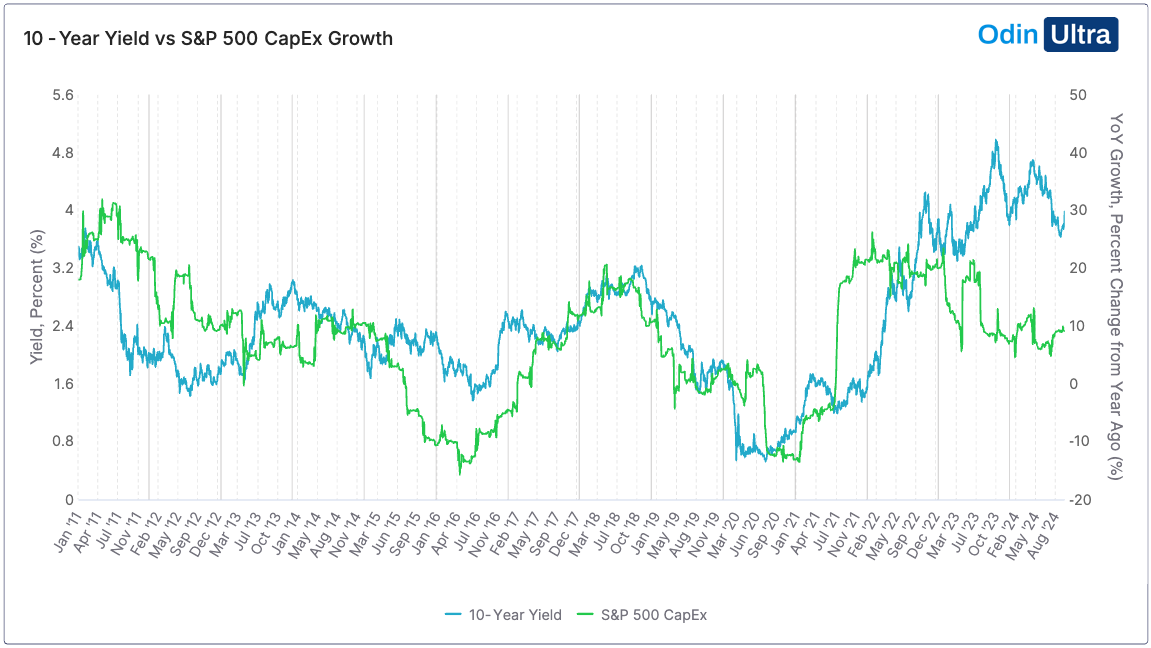
Our analysis reveals that the 10-year yield and the year-over-year growth of S&P 500 CapEx follow the same direction. Our findings indicate that movements in the 10-year yield lead S&P 500 CapEx changes by about a quarter, reflecting the time companies need to adjust to shifts in the financial and economic environment.
For 2024, our algorithms project mid-teens year-over-year (YoY) growth in S&P 500 CapEx — double last year’s growth rate — highlighting a significant acceleration previously noted in our data center CapEx blog. In contrast, for 2025, our models predict mid-single-digit YoY growth in S&P 500 CapEx. While this represents a deceleration, it remains at healthy levels. Notably, this trend does not extend to hyperscalers’ AI infrastructure spending, where we observe a shift from general expenditures to a concentrated focus on AI investments.
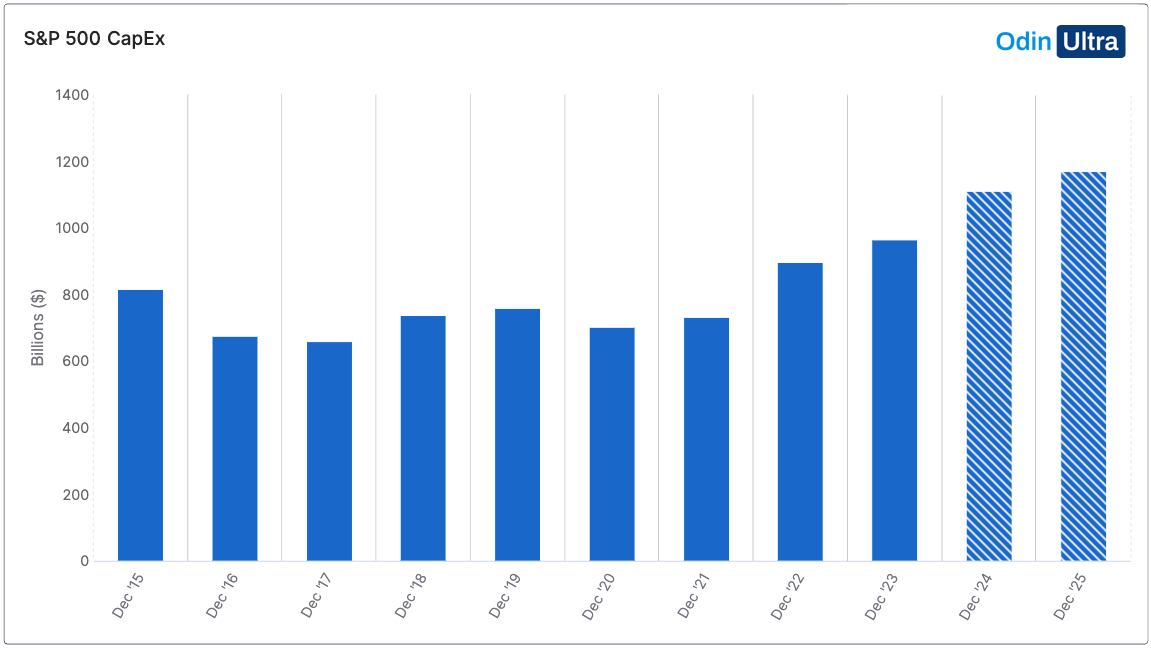
During this period, the Fed funds rate is expected to decline, likely exerting downward pressure on the 10-year yield. However, the 10-year yield may remain above pre-pandemic levels due to sustained inflation, economic growth, and/or rising federal debt. Nonetheless, CapEx decisions are complex, and corporate fundamentals and financial health remain essential factors beyond simply tracking yield fluctuations.
In a surprisingly counterintuitive conclusion, lower rates do not necessarily boost CapEx. Instead, the nuanced reality is that corporate America views long-term rates as a gauge of economic conditions, demonstrating that CapEx decisions are intricately tied to the outlook for growth and stability.
Published by Big Data Federation · All insights · Subscribe to Insights