AAPL Covered Call Strategies
By Big Data Federation, Inc.

As investor interest in a particular stock grows, many consider generating extra income by writing covered calls on it. While this may seem like a straightforward income strategy, simply selling call options against stock holdings can severely limit potential upside returns and may also trigger significant capital gains taxes due to the risk of assignment.
Designing and managing a profitable covered call overlay requires research and sophisticated tools. Options are inherently complex contracts with numerous parameters, making the challenge a true big data problem. While many tools can project the P&L of an options contract through expiration, there has been a lack of robust solutions to model strategies based on daily option premiums—until now.
Here, we demonstrate our experiment by engaging with our Financial AI to evaluate and compare several covered call strategies. Using Apple (AAPL) as the example, we tested two conditional covered call approaches and compared them against a standard mechanical covered call. To run the experiment, we simply entered the following prompt into the Financial AI:
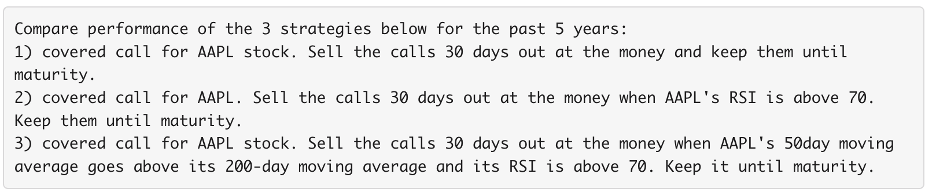
And that’s it. Within minutes, the Financial AI models all three strategies, builds a covered call overlay using real-time option premium prices, and manages the entry and exit of each position. (Note: to ensure a fair comparison, the system automatically closes option positions before assignment risk arises.)
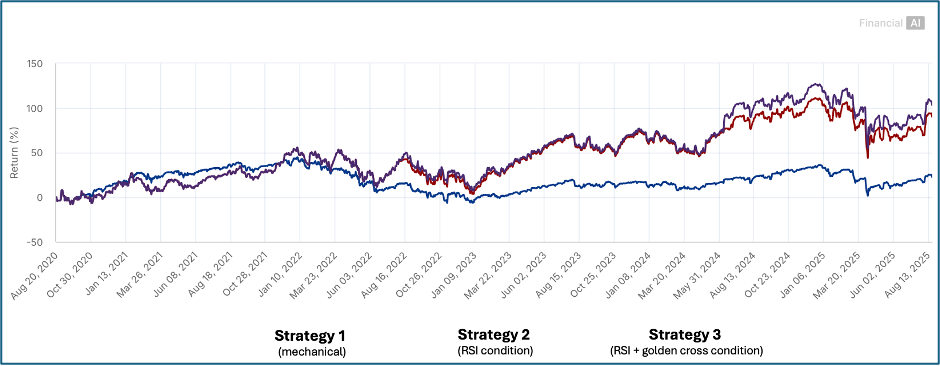
As shown below, with just a bit of effort and experimentation, investors can meaningfully enhance the return profile of a covered call strategy using the Financial AI system. In this example, applying a conditional covered call strategy—entering when RSI > 70 and stock’s 50-day moving average is above its 200-day (golden cross)—boosts returns by nearly 5x while simultaneously improving both the Sharpe and Sortino ratios.

We are entering a bold new era in asset management—one where Financial AI unlocks super-analyst capabilities for everyone, all through the simplicity of natural language. Of course, as you’ve heard many times before (and as noted in our disclosures too), past performance is not indicative of future results, and nothing here should be taken as financial advice.
The key takeaway is this: trading options has always required powerful modeling tools. But with the advancements we’ve built into Financial AI, investors now have access to capabilities that push far beyond what even top-tier quantitative hedge fund managers rely on.
Published by Big Data Federation · All insights · Subscribe to Insights